

Sometime between 1750 and 1820, an elegant period of music emerged, during which refined composition, with refined textures and distinctive phases, took center stage. This timeless piece of culture from the European region is widely known as the classical period, and it produced brilliant composers like Ludwig van Beethoven, Johann Sebastian Bach, and perhaps none more famous than Wolfgang Amadeus Mozart.
Born in 1756 in the small Austrian village of Salzburg, Mozart was widely recognized as a child prodigy because of his vast musical skills, which took him on a tour across Europe. Building a reputation before even becoming an adult, it could be argued that some were envious of Mozart’s otherworldly abilities, and this is partly the focus of the 1984 biographical film Amadeus.
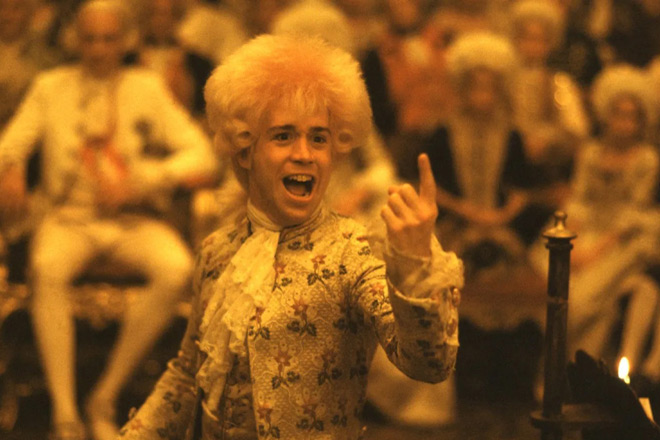
Directed by Czech Filmmaker Miloš Forman (who was responsible for other exceptional films like 1975’s One Flew Over the Cuckoo’s Nest), the script was adapted by English Playwriter Peter Shaffer from his 1979 play of the same name. Interestingly enough, Shaffer’s story was inspired by the 1830 Alexander Pushkin play Mozart and Salieri, in which Italian Composer Antonio Salieri is shown with great disdain and admiration for Mozart, which goes as far as depicting him killing Mozart on stage. This was a source of inspiration for drama, and it has followed along throughout history with speculation that in real life, Salieri poisoned Mozart, who tragically died at the young age of thirty-five years old.
While no one really knows the truth about Salieri and Mozart, or if Mozart was really poisoned, the reality is that Salieri was tremendously affected by the serious accusations. In fact, it eventually led to him having a nervous breakdown later in life, where he was checked into a Vienna hospital. So, knowing the real history of the situation makes the plot of Amadeus that much more interesting because there are flickers of these truths mixed into this epic motion picture.
Released in September 1984, the film features an exceptional cast led by F. Murray Abraham as Antonio Salieri (who had just come off a striking performance in 1983’s Scarface) and a young Tom Hulce as Mozart (who until that time was little known except for his role in the standout 1978 Comedy Animal House). Beyond this, you also had young Actress Elizabeth Berridge (recognized until that point by Horror fans for her role in 1981’s Funhouse), who gave a powerful performance as Mozart’s wife, Constanze.
These three cast members alone sell a story filled with emotion, drama, and passion. With many scenes standing out, perhaps some of the most stunning is when Abraham’s Salieri is looking through original transcriptions of music brought to him by Berridge’s Constanze. In this, you see in facial expressions alone his sheer disbelief in the brilliance of the music. As striking as anything else in the film, the feelings in the scene are mixed with an inner hatred that Salieri realizes that he will never be as good as Mozart as the papers fall from his defeated hands straight to the floor.
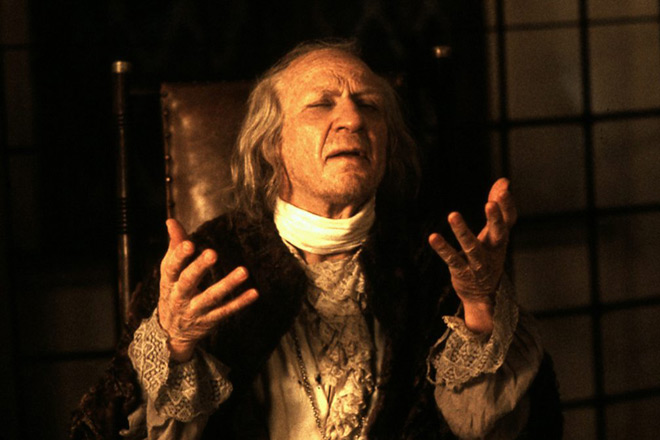
Just one of the many stand-out scenes in Amadeus; while the story is not completely based on true history, as stated, you can see how pieces of reality are sprinkled in a dignified fashion throughout. In all, the story is one that gives a glimpse into the brief yet outstanding musical career of Mozart. You see him as a child-like character who is beaming with confidence in his abilities. but with it, a sense of arrogance. You also see him as a true artist in every sense of the word, not driven by monetary gains but by creating the best music he could.
As if the name Mozart is not inspiring enough to a young musician, seeing these scenes play out in a motion picture feels almost like an affirmation of who they are and what they believe in rather than letting outsiders destroy their artistic spirit. Furthermore, the central focus of Salieri’s story is simply tragic because you can see he is not a wicked man but one who is so consumed with his own love for music. Still, he cannot get past the fact that Mozart is almost, without any effort at all, superior.
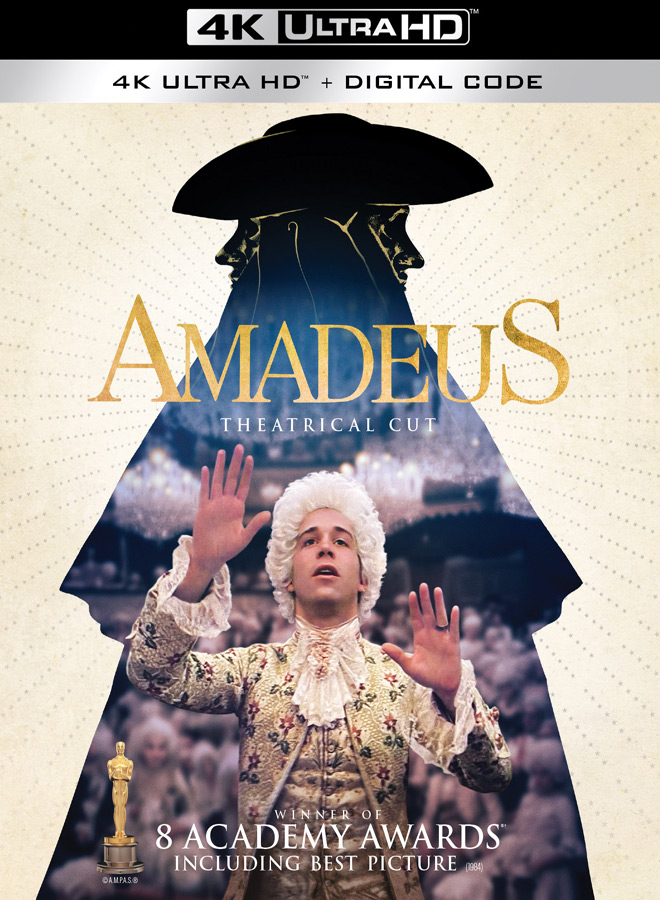
This makes for one of the most captivating feature films ever made. Many agreed because Amadeus was nominated for fifty-three awards and received forty of them, including eight Academy Awards and four Golden Globe Awards. With a whole lot of accolades, the film’s effect has not worn off in the last forty years since its initial premiere. Now, in 2025, in celebration of the film, Warner Bros. is offering the first-ever 4K Ultra HD remastering.
Released as a single disc set, as well as digitally, on February 25th, it is important to mention this new transfer is of the original theatrical cut and not the 2002 Director’s Cut. Looking at the Director’s Cut for a moment, it is widely known by many and includes twenty extra minutes. For some, the extra time is interesting, while others find it unnecessary. Up to individual preferences, if you own the 2002 Director’s Cut DVD, you cannot remove it from your collection; you can merely supplement it with this 4K Ultra HD remastered transfer of the theatrical version.
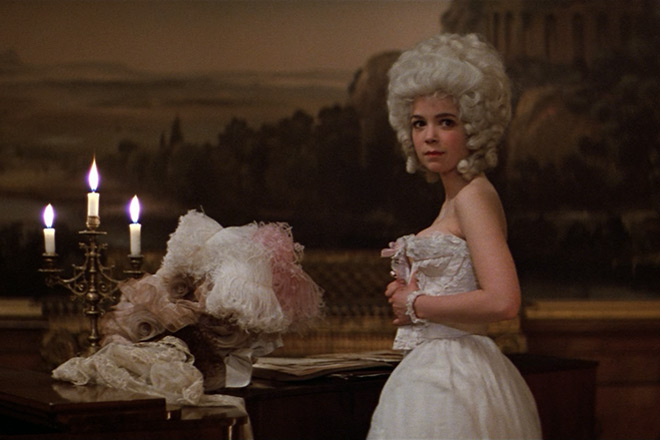
Marking the first time in over twenty years that the theatrical version is available for broad release, the restoration in 4K was commissioned in 2024 by Saul Zaentz Co. in conjunction with the Academy Film Archive and Teatro Della Pace Film. Taking everything into consideration, it was decided the theatrical edition would be used instead, and leaving your mixed feelings about this aside, the restoration of the film is simply stunning. Picking up a wider range of colors, there is a deeper contrast than before that is the most detailed since the 2009 Director’s Cut Blu-ray release. Well worth it; in addition, you also get a brand new Amadeus: The Making of a Masterpiece featurette, coupled with the older The Making of Amadeus documentary.
Overall, Warner Bros. does an exceptional job of providing a breathtaking 4K remastering of the theatrical version of Amadeus. That is why it is highly recommended that you sort out a copy because Cryptic Rock gives it 5 out of 5 stars.


)
No comment