
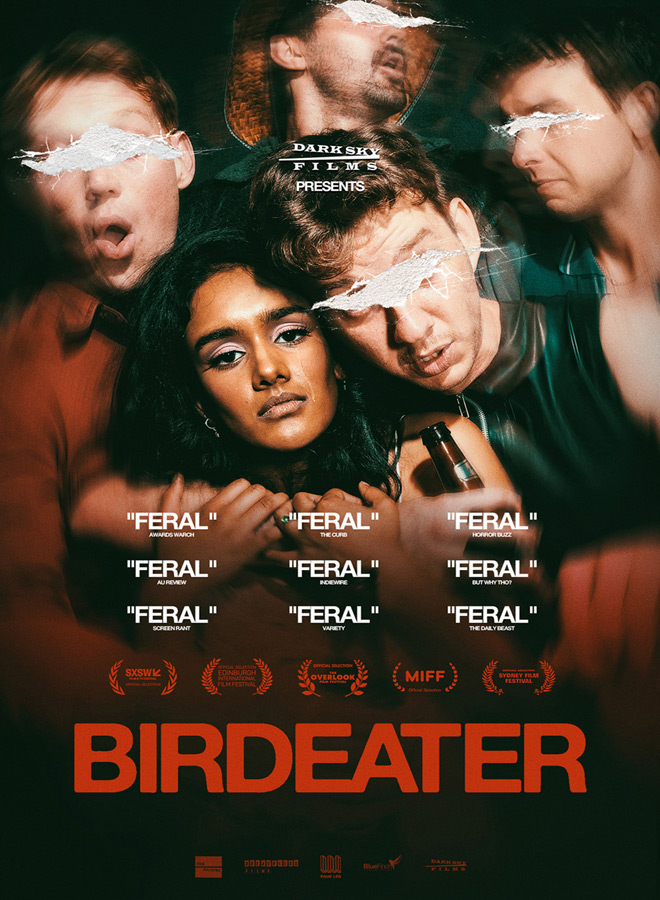
From its curious opening shot to its provocative script, Birdeater is a chemically induced whirligig of control and toxicity… Or is it? See what you take away from your experience when Dark Sky Films delivers the Psychological Thriller to select theaters and VOD on Friday, January 10, 2025.
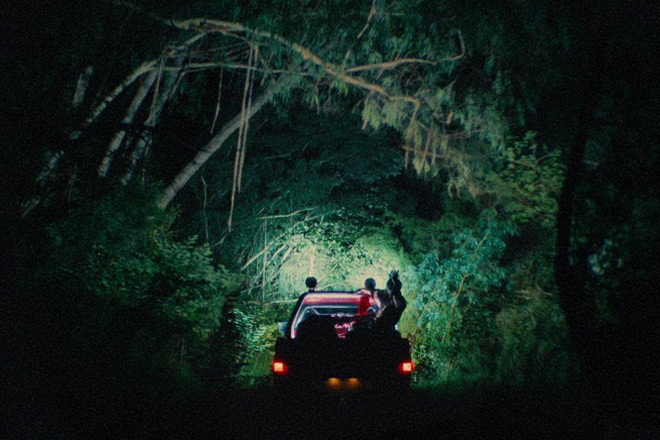
Presented by Australian writing-directing duo Jack Clark and Jim Weir (No Burn Day mini-series), the 115-minute film is an intriguing exploration of modern relationships. Centered around twentysomething couple Louie (Mackenzie Fearnley: Dance Academy: The Movie 2017, Operation Buffalo mini-series) and Irene (Shabana Azeez: The Hunting mini-series, Metro Sexual series), this is the story of a buck’s weekend gone feral.
A visually arresting psychotropic journey into a world of coercion that culminates in a disturbing reckoning, Birdeater is a film fraught with immediacy. And tasked with bringing a complicated yet often carefully ambiguous script to life, its cast is impressive. The somewhat novice ensemble includes Clementine Anderson (Harrow series, Home and Away series), Jack Bannister (Pieces of Her mini-series), Ben Hunter (Mr. Inbetween series, RFDS series), Alfie Gledhill (With Intent mini-series, The Lost Flowers of Alice Hart series), Harley Wilson (Threshold short 2020, Break Up Scene short), and Caroline McQuade (Without a Tracey mini-series, Public Eye 2021).
Calculated. Divisive. Modern. Part Psychological Thriller, part dark commentary, Birdeater explores polarizing territory—and its audience could easily be split by gender. This makes a fact that would rarely be worth noting—that its writers are men—a bit more intriguing. Because somewhere in this mix of “He Did” and “She Did,” there is a definite theme of toxic masculinity.
From the first moments of the film, this poison emanates from the pores of Louie and Irene’s relationship, from the boys just being boys content, and especially from the points-of-view depicted by each of the male characters. (Except Sam, who is, of course, the odd man out.) This is, in some senses, a psychological Lord of the Flies where everyone is simply trying to survive with their comfortable yet monotonous existence intact. And it is dull because each individual would much rather ignore glaring red flags and find obliviousness in pill form rather than speak up, communicate effectively, and stop riding the toxic merry-go-round. Well, at least the ladies.
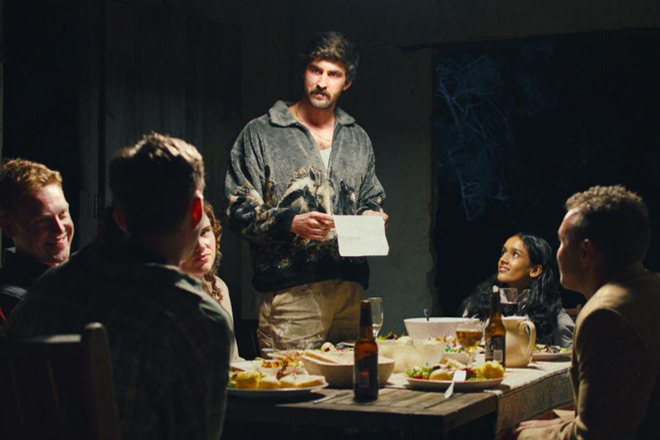
And yet, are these not the parameters that many of today’s women live within? We find a suitable partner, settle in, and become comfortable, if not entirely happy. The entire foundation of these relationships is rinse and repeat, ad nauseam. Those who refuse to take this path are seen as outsiders, like Sam, who is a bisexual polygamist; not a drunken buffoon or control freak like the other men, but seen as something “less” simply for his sexual orientation.
Though none of this is the heart of Birdeater. Instead, its heaviest weight comes in the form of a pivotal discussion that is apt to be triggering for some (but handled with great respect). Clarke and Weir’s script is meant to provoke a complex discussion about control, toxic traits, and what passes for “normal” behavior in 2025. Its dialogue-driven meat begs us to consider what a “good man” is. When an individual’s malignant actions are covert so as to seem less severe, is this man somehow “better” than the overt abuser? Where is the line that separates the “good men” from the “bad men”?
And the same can be said for women. Though she is the most relatable character within the seven, Irene is not without tragic flaws. Grace, too, is not a saint. Each of the partygoers is a multi-faceted character who is neither wholly innocent nor entirely evil; they are a complicated mix of horrible mistakes and calculated control. Or, one might even say, a knotted blend of apathy and dominance.
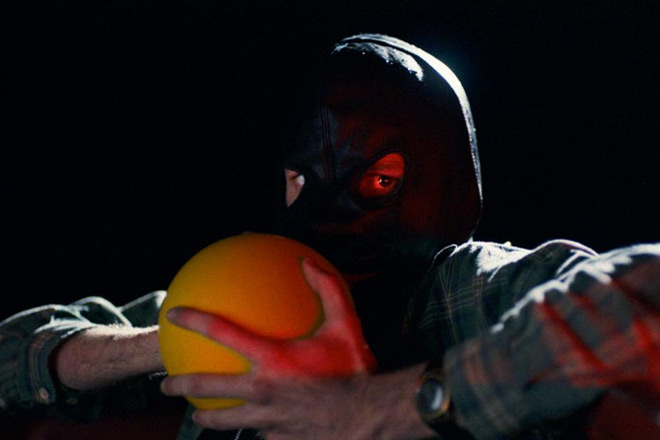
Birdeater’s strength, therefore, comes in the tangled connections between its characters. For this reason, the film is dialogue-driven and not something that can serve as simple background noise on a lazy day. Visual and auditory cues are part of the syntax and are important to the moviegoer’s takeaway, making this a poor choice for the passive viewer.
But for anyone looking to unravel a complex and twisty psychological romp, there is something haunting about Birdeater, an uncertain certainty that lingers far beyond the film’s end credits. For this, Cryptic Rock gives Clark and Weir’s phenomenal feature debut 4 out of 5 stars.


)
No comment