
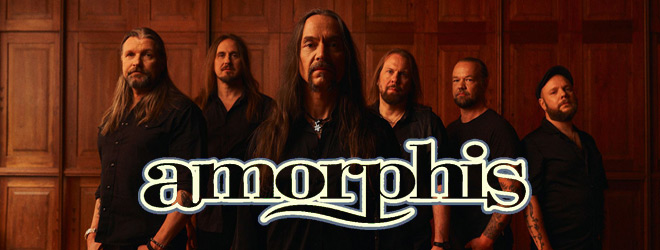
After releasing Borderland in 2025, their fifteenth studio album since forming in 1990, Amorphis is now firmly established not only as one of Finland’s best Heavy Metal exports but also as one of the best Melodic Death Metal bands of all time. Their unfailing blend of the hard and melodic, combined with a progressive edge that never loses the script, has resulted in some of the strongest and catchiest songwriting.
This is evident on Borderland, a powerful and flowing work sure to delight fans the world over while bringing in still more to their growing horde of loyal supporters. Recently, founding Guitarist Esa Holopainen and longtime Keyboardist Santeri Kallio, two of the band’s driving forces in songwriting, sat down to discuss all things Borderland.
Cryptic Rock – With the release of Borderland, you reach full-length album number fifteen in this glorious career. Every few albums, you like to switch producers to keep things fresh. And switching from Jens Bogren to Jacob Hansen, what would you say has been the difference in working with him versus Jens?
Esa Holopainen – Well, he’s a very different kind of person. He’s not that picky about arrangements and the songs. He lets the band play their own stuff, and that’s pretty much how we did it. I think he didn’t change basically anything at all from the first arrangements that we as composers had. So, I think he mainly focused on keeping the good mood on, and I think his touch is more within the mix.
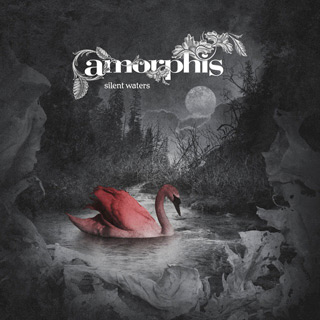
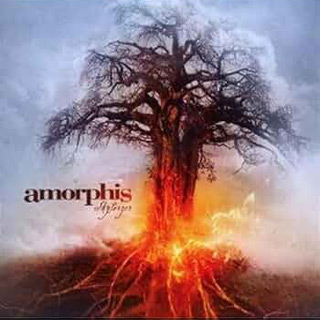
Santeri Kallio – Yeah, I think working with Jens was more like, he took the whole project under control. He was really strict, already after the demos, he made suggestions, and would point out which kinds of vocals should be put in place where, and so forth. He kind of stepped into the band as a seventh member. But obviously, we didn’t know what to expect with Jacob Hansen, because we didn’t really investigate his working habits. When we entered the studio, Jacob didn’t take the authority as Jens did totally, like all the tiny details, and he told the bass player, “You play like this,” and the guitar player… Not always, but some parts, but Jacob didn’t take that authority at all. So basically, he told us that, “You guys have to make the music by yourselves. I’m not going to intervene with arrangements unless there’s an absolute need to change something.” So, it was kind of a shock for us. And we got back to the roots with the albums Far from the Sun (2003), Eclipse (2006), Silent Waters (2007), and Skyforger (2009), which were self-produced.
So we basically played whatever we wanted, which sounded good to us, and nobody said anything. Nobody said anything, like, “You have to make changes” or something. So, it was kind of a shock because we were used to Jens after three albums. So eventually, I think we ended up doing kind of like a band album. The band had total freedom to do whatever they wanted. Obviously, the demos were pretty well arranged, and everything was set, so nobody said anything. We made a kind of band album under the supervision of Jacob Hansen. He did say something, but it was so little, it’s really hard to say. And mostly, he concentrated on making the sound as big as possible, and selected the songs and selected the track list and stuff like that.
Esa Holopainen – He was too kind a person to say anything.
Santeri Kallio – He was very kind, but I think eventually it was a positive surprise because we are pretty talented musicians. We’ve been together for 30 years. We know how to make a good-sounding album already before we even went to Jens, because we did so many albums just by ourselves. But it was kind of going to the uncomfortable zone back then because we thought he was going to manage everything, and you could just go there, “Okay, what do you want me to play?” But no, no, no. Jacob said, “You play whatever you want.” And if there’s some shit coming out of your persona, then he will change that. But he didn’t really change anything. And I haven’t heard from the other guys too who work with him deeply. I recorded by myself, and Tomi recorded his vocals by himself, but I haven’t really heard from the guys that he was changing anything.
Esa Holopainen – Some drum details during the drum recordings, I guess.
Santeri Kallio – Yeah, some drum things like, “This could be more powerful like this.” Like the same shit you do always with drummers, like, “Please, play less.”
Cryptic Rock – That is interesting. Borderland is a beautiful-sounding album. If there is an immediately recognizable difference to point out between Halo and the new one, it seems like you guys took more advantage of Tomi Joutsen’s clean vocals. I think the harsh vocals were placed in the background a little bit. The growled vocals figure more heavily in the song “Bones”, which is such a heavy percussive song, yet there is still so much melody, an Amorphis staple. Was there something about this album that you guys collectively decided, ‘We want to take more advantage of his clean vocals,” or did that just happen organically?
Esa Holopainen – Well, on this album, like usually, Tomi works with a vocal producer, Jonas Olsson, and that’s the way he wants to work it out. And we are basically like two camps. It’s us who are working with the music and rehearsing the music, and then Tomi is arranging the vocals with Jonas. So it’s pretty much up to them where they put the growling vocals and clean vocals. But I have to say, Tomi did a really, really good job with vocals on this album. He’s probably at his best. I don’t think he ever sang as well as he did on the Borderland album.
The usual problem with the growling vocalists is when they suddenly want to also do clean vocals, like the proper vocals, and their voice is not educated at all. And it sounds like a school kid starting to sing. That’s usually what happens when the growling guys want to start to do the clean stuff. But with Tomi, since the beginning, we realized that his talent is really in the clean vocals. And the bonus was that this guy can also growl really well. And we’ve been really fortunate in that, because there are not that many singers who can really properly sing well, plus do the growling vocals well. So he’s really, really a special dude in that way.
Cryptic Rock – And Tomi Joutsen is the longest serving vocalist in Amorphis’ history, at this point, by several years. Santeri, as someone who consistently creates keyboard solo ‘leads’ in the music, providing similar textures to something like Rush’s “Subdivisions” Are these solos deliberately worked into the music like the guitar solos? Do your keyboard solos and the departures where you’re getting creative? Is that something that happens organically, or do you try to make it important to you to implement that into the songs?
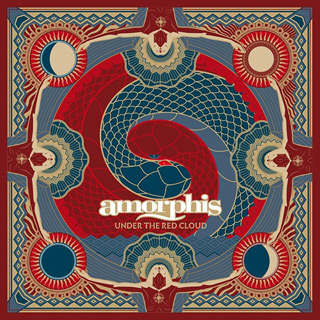
Santeri Kallio – Well, if there’s space, I can fill it up with the solo or fill it up with something else. But yeah, I love to do them sometimes, especially with an interlude with Esa, like a dialogue, like what we’ve had on the song “Under the Red Cloud,” for example. But mostly, planned already in the demo phase. But, for example, on “Tempest” off of this latest album, I asked Esa, “Okay, let’s make it a little bit longer after the hard drop-down and play some epic solo there.” But then he played such an epic solo, so I added one later, which wasn’t planned. I added kind of like an intro solo to guide it through to Esa’s. But yeah, well, I don’t necessarily need to do any solos, but I think the keyboard solos actually fit in our music pretty well and with them, you can bring something new to the table, instead of just going from verse to chorus, verse to chorus, guitar solo, verse to chorus modulation.
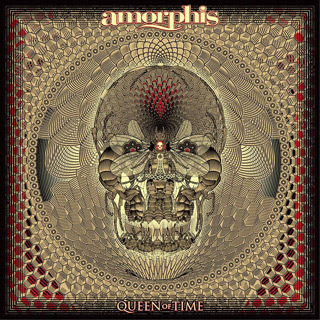
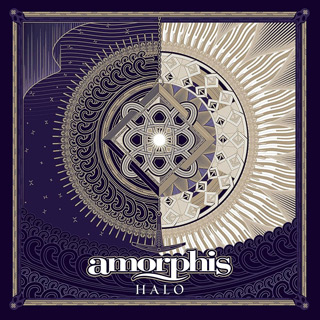
So, it’s kind of a funny way to bring something new to the table and take the music in a little bit of a different direction, achieving different emotions. But I’ve had times with Jens Bogren, for example, on Halo, he cut many of my solo tryouts straight from the album because he wanted it to be such a guitar treat and shit. So obviously, I always try to smuggle them in, but I don’t consider them like my babies. If it really doesn’t fit, it’s totally fine to drop it. But mostly, with this album, I added the solos in the process when I hear how the vocal dynamics are going. And if there’s some space where you could fit in, I kind of add them, but they’re not that important for me. But I love the idea that we have a possibility to do that with Esa and me, or just Esa or just me. It’s always fun.

Cryptic Rock – It is like adding a third guitar, in a way. There’s a magic in what Amorphis does that is rarely found in other similar melodic death metal bands. The ability to keep that going over this many years and this many albums is remarkable in and of itself. On Borderland, was there a unifying lyrical theme that united the album? And if so, what was that theme and how did you guys arrive at it?
Esa Holopainen – Well, there is not any one lyrical theme. Pekka Kainulainen has been doing the lyrics. He’s been working, obviously, with the instruments as well. It’s more based on the spiritual world and the connection between the living world and the spiritual world.
Santeri Kallio – I would say there is no one theme that Borderland is about, but when I read the lyrics by myself, I think there is a strong connection between all the lyrics that they are about the present, the past and the underworld. Or the dream world meets the present world, and how they discuss with each other, or give guidance, or you ask something, or something appears to you from your dreams. So I think that’s definitely kind of a theme, but I would say it’s not the topic or the guideline, it just happens that all the texts have some sort of a discussion or a speculation about like Tomi said in some interviews, that we are living in a present world, but everything what happened before, you can’t just deny it and forget it, and all the good and bad that everybody has. They try to be good, but there’s always something bad that we can’t fucking get rid of. It’s impossible.
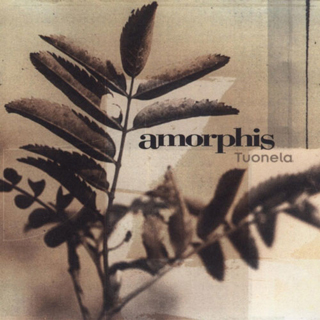
But for me, the theme, after I read the lyrics a couple of times, I think the theme is that it’s a communication between the dream world and the present world, the underworld, Tuonela in Finnish, from Finnish mythology. It’s not a bad place, but it’s kind of like the place where the past happened. You can perhaps receive guidance from this place.

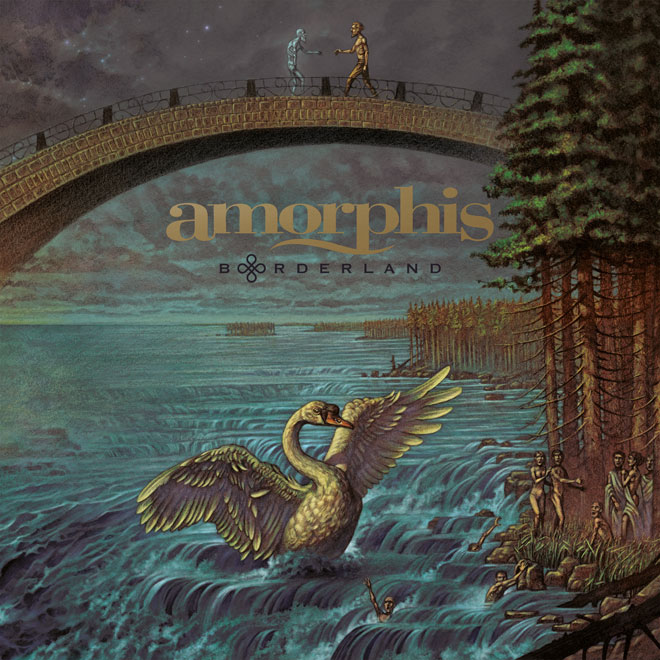
Cryptic Rock – And an argument can be made that we need that now in this crazily digitized social media world where we’re just constantly separated from our roots by this awful atomized, “Feel this way, be outraged.” The album cover is amazing, perhaps reminiscent of the older album covers from the mid-2000s. Was that deliberate? How did you decide upon the Borderland cover art?
Esa Holopainen – We started to figure out different artists. As we changed the producer, we also wanted to change the cover artist. We ended up asking for cover art from Marald Van Haasteren, a Dutch artist. He has done a lot of artwork, even for bands like Metallica and so on. But he’s really good with drawing animals and nature stuff. So that fascinated us. And Tomi Joutsen had some slight ideas after pondering the lyrics and what’s happening in there, so we wanted to have some elements that are connected to the lyrics. Marald did great work, and he’s like an old-school painter. He paints all the stuff, which was really important because there are a lot of artists these days that work with AI, and you can pretty much spot it immediately when you have AI on, which is horrible. It is great to have a real, proper artist’s fingerprint on the cover, and he did the whole package, all the additional artwork as well, based upon lyrics on “Light and Shadow,” “Dancing Shadows,” and “Bones.”
Santeri Kallio – I think it’s a great move to finally get back some of the real artwork stuff. With Valnoir, we did three albums, and they go more in the psychedelic direction. But with Borderland, it’s pretty much when you read the lyrics or listen to the album, and you watch the cover, you basically understand that there is the river between the underworld, Tuonela River, and then there’s the bridge to our world. And so, I don’t know how the hell he managed to do that. Maybe he read the lyrics a couple of times through, but I love his work. It’s more realistic and very colorful. I like psychedelics too, but I think three albums with psychedelics is enough.
Cryptic Rock – Part of Amorphis’ enduring legacy is your ability to never stagnate. This creative core has been together a long time. Do you feel a lot of stress or pressure when it’s time to make an album? Or are you so reliant upon the chemistry that you guys have? How does Amorphis deliver time after time to this extent?
Santeri Kallio – Maybe because we don’t stress. I think in making music or any art, the more you stress, the less you get. So obviously, it’s a stressful process, but still you have to rely on the trained musicians and also the band, and also yourself to keep on pushing and do a lot of hard work to get good music out of yourself. Sometimes it takes weeks. First ideas, they’re okay, but they are not maybe at the level of what we actually expect. Borderland is our 15th album. You can’t put out any mediocre shit. Or you can, but that’s pretty dangerous, and it’s quite boring because you have to play all that music for at least a couple of years. So yeah, I wouldn’t use the word stress. I would use labor. You have to work a lot to get that music out of you. And eventually, it will pay off because we’ve been together for so long. And sometimes there are good surprises, sometimes there are bad surprises, but mostly good.
Cryptic Rock – Fifteen albums in, and the chemistry in Amorphis is undeniable. On the last few albums, you have brought in a guest vocalist, usually a female, such as Anneke Van Giersbergen, for one song. Not so on Borderland. Was there any deliberate discussion about this, or did it just materialize this way without guest vocalists?
Santeri Kallio – I would say we didn’t do that because the producer didn’t take the authority and say, “Now, we’re going to do this.” We talk about it with the band, but as we’ve spoken in many interviews, we’re six guys in the band, and everybody thinks differently. It was just a big disagreement. Somebody said, “We could do that.” Somebody’s like, “Fuck no.” Then we spoke about, “What could it be? Who would it be?” We didn’t agree on anything, so we couldn’t agree on anything. And now, listening to the album, I don’t think there would have been any spots for a guest singer. It’s good to have a band album. The album sounds like Amorphis. There aren’t too many extra elements, choirs, or big string orchestra or anything like that. It’s kind of like Amorphis how it sounds in our ears when we play a show or something. There are no extras.
Esa Holopainen – There is one additional dude, Francesco Ferrini, who did orchestra arrangements for our previous albums, but it’s very mild on Borderland, I guess. It’s just a little flavor here and there to uplift some of the songs. I feel that now, when you listen to the album, it really doesn’t need any guest vocals. Sometimes, like with “Amongst Stars,” with Anneke Van Giersbergen, it was Jens who had the idea. And he knew as a producer, “Okay, this will be a great duet.”
And the same thing with the Halo album, the ending song, “My Name Is Night”. So that was like, okay, it’s a very different kind of song. It’s like a slow emotional song, with some help from female vocals, and it fits perfectly. I remember the discussion we had in the studio between the guys, like, “Okay, could it be possible to take somebody else on for some of the songs?” And it was just endless discussing, “No, not that one. No, I don’t like that one.”
Santeri Kallio – Endless disagreement. But I think there was no “out of the box” song in this album. “Amongst Stars” was very poppy; it was a totally upward-going, like a poppy, melodic song. So it was easy to say ok, here we could use a duet. Also, My Name is Night in Halo, it was such an out-of-the-box song. It was really hard to hear that Tomi would suddenly change into a very sensitive man to sing… But it was quite obvious that these out-of-the-box songs can use some extra help or extra dimensions. But in Borderland, I don’t think there are any out-of-the-box songs, which we would’ve needed some extra elements.




No comment