Releasing their debut self-titled album in 1994, in the decade to follow, Southern Californian band Korn went on to release five more studio albums, sell roughly 28 million records, achieve 28 highly charted singles, and become one of the premier Alternative Metal bands in the universe. Astounding accomplishments: they not only had success but also pioneered what some called the Nu Metal sound, which influenced a massive movement that grew with bands like Limp Bizkit, Coal Chamber, and later Slipknot.
Sustaining themselves for ten years, Korn’s popularity grew with each passing release through the ‘90s, with two straight number one albums in 1998’s Follow the Leader and 1999’s Issues, followed by two more top ten albums in 2002’s Untouchables and 2003’s Take A Look In The Mirror.
Seeming like Korn could do no wrong as they cruised into the new millennium, uncertain roads lay ahead. Working regularly since 1994, touring and putting out music, the band had been through a lot in this period. Then a big blow came in early 2005 when co-founding guitarist and key songwriter Brian “Head” Welch decided to leave the band to improve his own life amidst a struggle with addiction. A massive part of the Korn sound with his unique guitar riffs, Korn were faced with – Where do we go from here? Opting not to replace Welch, but to carry on as a four-piece, Vocalist Jonathan Davis, Guitarist James “Munky” Shaffer, Bassist Reginald “Fieldy” Arvizu, and Drummer David Silveria entered the studio in the summer of 2005, ready to create their next album.
Over five months, Korn went into these recording sessions at Davis’s home studio, seeing Welch’s loss as both a setback and a chance to reinvent themselves. A great way to spin a negative situation: Davis collaborated with a new team of producers, including Atticus Ross, the more Pop-oriented producer behind The Matrix. A move that saw a curious pushing of the envelope, the core of Korn interjected a few different sounds into the band’s repertoire, including more Industrial and darker electronic elements.
An experiment that could be seen as a risk, it worked out well for Korn because many listeners openly accepted the album they ended up calling See You on the Other Side. Hitting the public on December 6, 2005, many praised the more dynamic textures heard throughout the record, and, thanks to dedicated support, See You on the Other Side debuted at number three on the Billboard 200, selling over 220,000 copies in the first week alone. Anchored by the hit singles “Twisted Transistor” and “Coming Undone,” the album was certified platinum within four months.
Proving Korn still had the magic brewing within them, See You on the Other Side had plenty more to offer than a few singles. Looking deeper inside, songs like “Hypocrites” were rather memorable, as were the heavy “Liar,” and hooky “For No One.” Fourteen songs in total, the album was the beginning of a new era for the band, which continued to tinker with different sounds as heard on future albums such as 2010’s Korn III: Remember Who You Are (which was more stripped back) and 2011’s The Path of Totality (which is heavily Electronic Dance influenced). An essential piece of their history, now in 2025, there is a chance to own See You on the Other Side on vinyl.
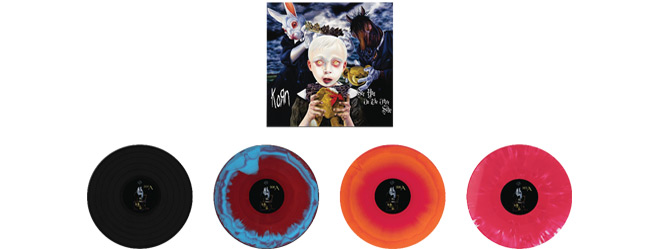
A part of the album’s 20th anniversary celebration, the first-ever vinyl pressing of See You on the Other Side arrives November 21, 2025, via Tempo Music. More than just a vinyl reissue, this new edition will be available in several variants. Breaking them down, there is an exclusive blue/red-blended 2LP set on Korn’s website, an orange/violet-blended 2LP set through Hot Topic, a magenta/cloudy 2LP set through indie record stores, and a standard black vinyl 2LP set through many other retailers. Each is a great option, but the new release also includes the bonus track “Last Legal Drug (Le Petit Mort),” previously unavailable anywhere and available only on the deluxe CD edition from 2005.
A fantastic extra, the 20th anniversary vinyl edition of See You on the Other Side also features the original, dazzling artwork by NYC-based Surrealist Artist David Stoupakis. Looking good, inside and out, the vinyl transfer is also of high sonic quality, making this a coveted edition for any Korn fan’s collection. That is why Cryptic Rock gives the 20th anniversary vinyl release of See You on the Other Side 4.5 out of 5 stars.






)
No comment