The controversy of psychiatric institutions has been ongoing for hundreds of years. A debate still had by many, the first stem of questioning came in the 18th and later 19th century, after ex-patients expressed the inhuman treatment they experienced while inside. Jumping forward to the mid-20th century, there was a movement to assimilate institutionalized individuals out of large-scale state facilities into the community. At the time, a noble human concept, historically, there was little support for these individuals in the outside world, and a lack of follow-ups to ensure they were alright. As a result, you can argue that it led to increased homelessness, an increased number of incarcerated individuals, and an overall unsafe situation for everyone involved.
Nonetheless, this issue is still very present in modern-day society, where some believe the pharmaceutical industry has taken over mental health with an assortment of antipsychotic drugs. Again, up for discussion: estimates indicate that, in the United States alone, roughly seven million people were prescribed some of the neuroleptic medications in 2025. Startling statistics, no matter what one’s opinion might be… it should at least raise a question.
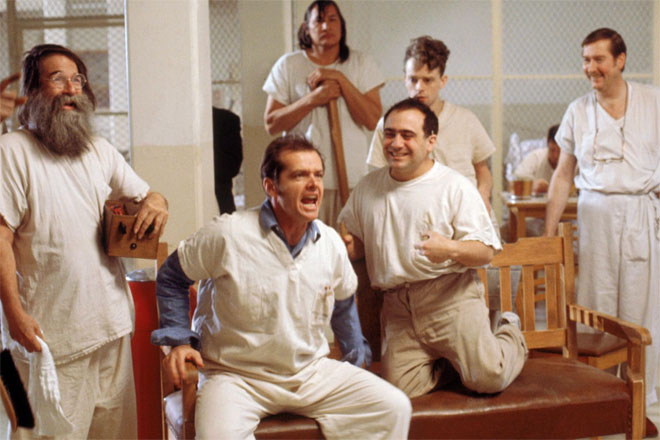
A dose of reality that everyone should ponder, in the world of cinema, the 1975 film One Flew Over the Cuckoo’s Nest was a gut-wrenching glimpse into the psychiatric world. A film with many layers; some call it a Comedy, others might call it a Drama. In truth, no one answer is right or wrong, because One Flew Over the Cuckoo’s Nest has a little bit of everything involved.
Released through United Artists on November 19, 1975, the road to the big screen was a long, winding one that lasted a whopping thirteen years. Based on the striking 1962 Ken Kesey novel of the same title, the rights to the story were acquired shortly after publication by Kirk Douglas’s company, Joel Productions. Outbidding Jack Nicholson for the story, ironically, the actor would go on to be cast as the lead character, Randle “Mac” McMurphy.
A struggle with many twists and turns, some of the most significant issues surrounding One Flew Over the Cuckoo’s Nest were financing: many studios felt the theme was too dark for commercial success, but a major deal-breaker was their yearning to change the ending. Thankfully, under the production rule of a young Michael Douglas (who would later achieve massive success as an actor), he stood firm that the film’s conclusion was detrimental to its overall message.
Which leads to the looming question – what exactly is the message behind One Flew Over the Cuckoo’s Nest? Well, that is open to interruption. Some believe the proper context of the story is best conveyed by reading the Ken Kesey novel, which is far more descriptive. Taking this argument into consideration, let us agree that One Flew Over the Cuckoo’s Nest is clearly about the mistreatment of those struggling with illness. Although if you look more closely, the underlined message is also one about overbearing, and it is a metaphor for how society seeks to squash the human spirit into conformity.
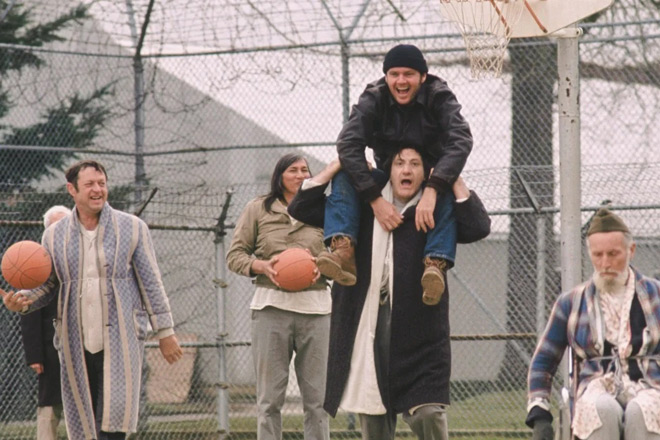
Nonetheless, as with any film adaptation, changes occur. Just the way it happens, in fairness, the screen adaptation of One Flew Over the Cuckoo’s Nest (from the Award-winning WritersLawrence Hauben and Bo Goldman) is exceptionally well done, bringing everything to life. Joined with the direction of Miloš Forman (who did a stunning job with later films, including 1979’s Hair and 1984’s Amadeus), the film’s success lies in the cast themselves.
As mentioned, with Jack Nicholson as the lead, you immediately have an attention-grabbing performer who plays McMurphy flawlessly. A role that would be the catalyst for Nicholson’s career, it led to other iconic off-kilter performances, such as in 1980’s The Shining and as The Joker in 1989’s Batman. Solidified in One Flew Over the Cuckoo’s Nest by a supporting cast for the ages, you had a mix of veteran and up-and-coming stars popping up everywhere.
Breaking it all down, McMurphy’s instiution mates include a young Danny Devito (a few years before his role in the hit series Taxi) as the child-like Martini, Christopher Llyod (as before his role on Taxi and long before 1985’s Back to the Future) making his film debut as Max Taber, the talented Sydney Lassick as the whiny Charlie Cheswick, a then-unknown Brad Dourif (who would go onto portray the iconic Horror villain Chucky in the Child’s Play franchise) as the insecure, stuttering Billy Bibbit, and Will Sampson (who went onto to roles in 1977’s White Buffalo and 1986’s Poltergeist II: The Other Side) as the silent, yet opposing Chief Bromden. Truly bring each character to life in a very human way, they were joined by the award-winning Louise Fletcher as the cold, controlling Nurse Ratched.
A film more about the characters than anything else, One Flew Over the Cuckoo’s Nest sought to be as authentic as possible, choosing to shoot at an active institution with real patients as extras. Factors that make the film one of the greatest institutional films ever made: it would go on to win five Academy Awards and became the highest-grossing film at the box office in 1975, right behind Steven Spelbeig’s juggernaut, Jaws.
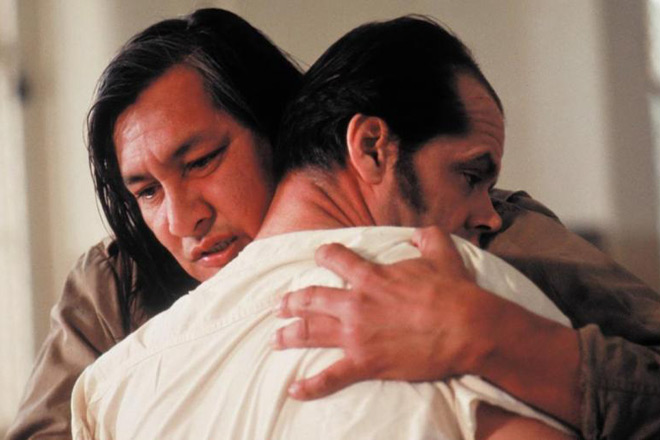
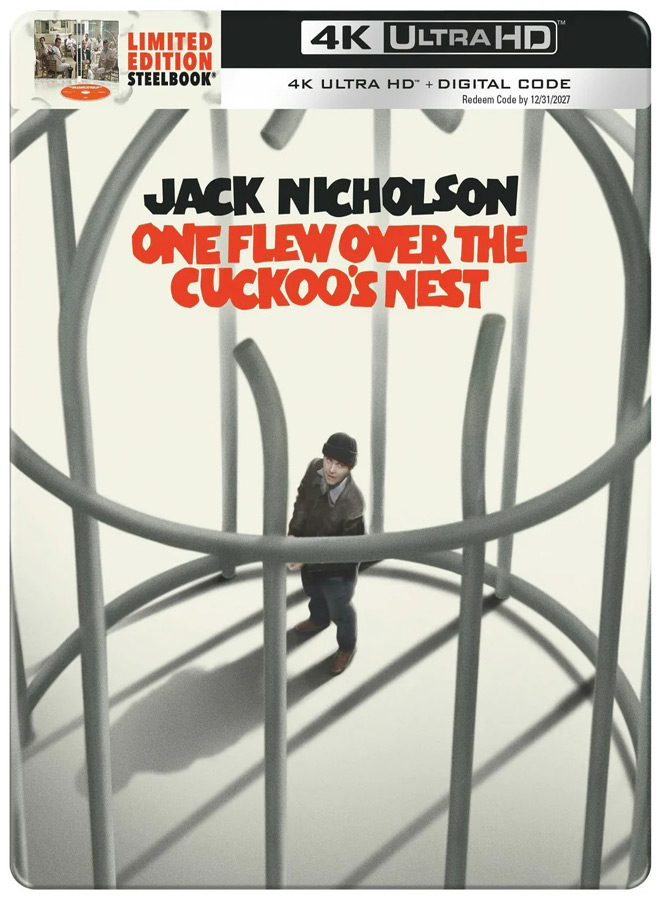
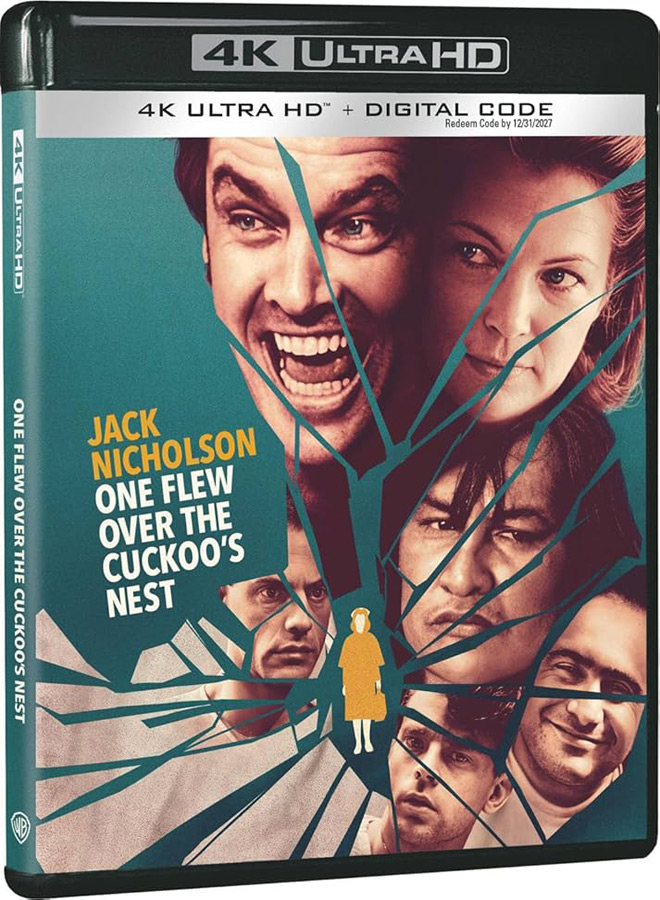
Still considered by many to be one of the greatest films ever made, fifty years later, One Flew Over the Cuckoo’s Nest is as profoundly thought-provoking as ever. Re-released in theaters through Fanthom Entertainment in July 2025 as part of the 50th anniversary celebration, on November 11, 2025, it arrived in 4K Ultra HD for the first time. Released through Warner Bros. Discovery Home Entertainment, the film is available in a standard 4K edition (with new art and a nice slipcover) or as a limited-edition steelbook.
Each being a fantastic option, it must be noted that the 4K Ultra HD transfer of One Flew Over the Cuckoo’s Nest is outstanding. Restored directly from the original camera negatives, it is by far the best viewing experience of the film ever put to market. Clean, crisp, and full of depth, even if you have seen it many times before, it feels brand new.
With all of this in mind, the additional bonus features for the 50th anniversary 4K Ultra HD release include two never-before-released featurettes, such as Conversations on Cuckoo: Group Therapy (which includes Michael Douglas, Danny DeVito, Christopher Lloyd, and Brad Dourif) and Conversations on Cuckoo: Moviemaking Memories, plus previously offered deleted scenes. Altogether, it is a great way to honor a film that strikes a nerve in all of our souls. That is why Cryptic Rock gives the 50th anniversary 4K Ultra HD release of One Flew Over the Cuckoo’s Nest 5 out of 5 stars.


)
No comment