
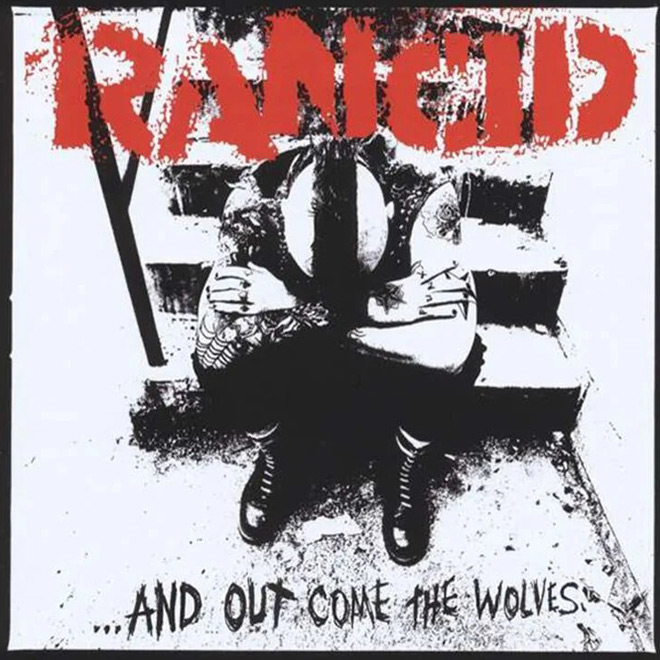
A Punk Rock mainstay, Rancid first released their self-titled debut album in 1993, built a more substantial following with the release of Let’s Go in 1994, and then exploded in 1995 with …And Out Come the Wolves. An album that is now thirty years old, many consider …And Out Come the Wolves and Rancid themselves key parts in bringing Punk Rock into the mainstream alongside their contemporaries, such as Green Day and The Offspring.
Looking back, Rancid initially formed in 1991 with Tim Armstrong on vocals and guitar, Matt Freeman on bass and vocals (who were formerly from Operation Ivy), and Brett Reed, who was soon to be recruited on drums. They would drop an EP entitled Rancid on Lookout Records before signing with Epitaph. To beef up their sound, they took on Lars Frederiksen as the second guitarist in 1992, which rounded out the classic band motif. They were completely DIY, with short, fast songs like those of the Ramones that came before them, characterized by relentless rhythm and, unlike the Ramones, shouted vocals.
This brief history laid out, on August 22, 1995, after about four months of recording, Rancid broke out with …And Out Come the Wolves, boasting classics like “Ruby Soho,” “Time Bomb,” and “Maxwell Murder.” A total of nineteen songs, at only 49 minutes, it was full force and stood out.
In hindsight, whereas Operation Ivy burned out after releasing an album and a couple of years, Rancid is still going strong, with their most recent album, Tomorrow Never Comes, released in 2023. This longevity is what And Out Come the Wolves encapsulates with themes of survival and loyalty. In fact, when Let’s Go started to make waves, the band could have easily followed the money, but Epitaph was where they made it, so they stayed in that sandbox. With that album gaining traction, the band had to navigate fame, identity, and the ghosts of their past. These new issues are also tackled on …And Out Come the Wolves.
Which raises a question many ask: Where do bands get album titles? With Rancid’s …And Out Come the Wolves, they drew inspiration from a line in Jim Carroll’s poem The Basketball Diaries, a symbol of the predatory nature of the music industry, musically blending Punk, Ska, and Reggae into a streetwise mosaic. Each track feels like a dispatch from a different alley, bar, or bus stop, like they had been a street band on the corner doing their thing with, say, their open suitcase for tips. This is not a put-down by any means; it is a testament to their accessibility, their ability to connect.
Rancid understands they did not create Punk, so they pay homage to those who came before from both sides of the pond, like the English band The Clash, whose fusion of Punk and Reggae was a blueprint for Rancid’s genre-bending style. Armstrong often cites 1979’s London Calling as a spiritual guide. The same could be said for Ska legends The Specials, whose offbeat rhythms and political edge made part of Rancid’s DNA, and Stiff Little Fingers & Sham 69, because of their working-class punk with anthemic choruses and worldly defiance. These influences are evident in “Roots Radicals” and “Journey to the End of the East Bay.”
On the American side of the pond, there was Minor Threat, which was raw, fast, and principled with their DIY ethic and intensity echoed in Rancid’s early work. Additionally, T.S.O.L. and Bad Religion were significant influences, with their melodic Hardcore style that incorporated a conscience, shaping Rancid’s lyrical depth and sonic punch. Not least, the Ramones and Black Flag, with their energy/attitude, particularly in their stripped-down tracks. Furthermore, Jimmy Cliff was a significant influence on their Reggae sound, with his soulful storytelling and rhythmic flow, which inspired Rancid’s Ska-Reggae mashups, such as “Time Bomb” and the heavier “Maxwell Murder,” which cover themes of street survival, addiction, violence, and ultimately resilience.
Displacement and escape with characters on the run, but still searching for belonging, can be heard in “Ruby Soho” and “Olympia WA,” representing opposite ends of the spectrum, with Soho, NY or London serving a double meaning since you can be in a swarm of people like the big city, but still feel alone. On the flip side, the big city can be a place for reinvention. “Olympia, WA” is about getting away from life’s craziness.
Finally, “Listed M.I.A.” and “The 11th Hour” discuss staying true to the scene, specifically the Punk scene, and not selling out for money while remaining grounded amidst potential fame. You can even throw “The Way I Feel” (the album’s last track) into this theme, but looking at it through the betrayer’s lens.
Tim Armstrong, always feeling like an outsider, has given voice to outsiders, punks, and wanderers for the last thirty-plus years with Rancid, never preaching, but just screaming it like it is. …And Out Come the Wolves has reigned supreme for thirty years in the pantheon of greats, talking about holding onto identity when the world wants to reduce you to dollars.


No comment