
What do you get when you join the romance of two people who share an interest in ‘50s Rock’n’Roll music and B-Horror Movies? Simple: you get the unforgettable band, The Cramps. The personal and musical love affair of Erick Purkhiser and Kristy Wallace began when they first met in Northern California back in 1972. Quickly realizing they had common interests in everything from Surf Rock and Rockabilly to Horror movies (like Mario Bava’s 1960 classic Black Sunday), it seemed only natural they would join the two into something creative. Doing just that, over the next few years, they worked on the band before forming a solidified Cramps lineup in 1976. Taking on the personas of Vocalist Lux Interior (Purkhiser) and Guitar Poison Ivy (Wallace), they would forever and always be the heartbeat of The Cramps.
Significantly unique to any other bands on the Punk scene at the time, The Cramps united Punk with Rockabilly and early Garage Rock (such as The Sonics) for a sound that was bizarre yet inviting. Pioneers, their sound would later be dubbed Psychobilly, inspiring a movement that continued with bands like HorrorPops, The Koffin Kats, and, in a more mainstream scene, Volbeat. Just being themselves and not concerned with anything else, The Cramps were raw and uninhibited, matched with a look that was provocative yet vintage. Also, a spectacle in a live setting, their performances were often described as chaotic, energetic, and full of theatrics that sprinkled in Horror film campiness and overt eroticism. In many ways, listening to The Cramps felt like an EC Tales from the Crypt comic meshed with a naughty magazine come to life.

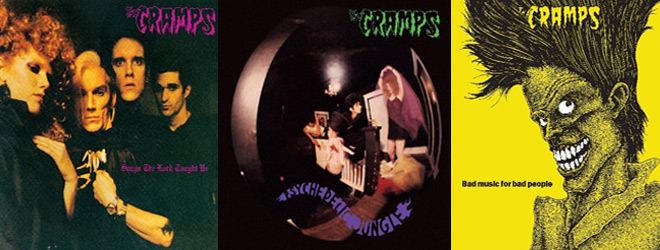
Never to be replaced, in 1980, The Cramps released their debut album, Songs the Lord Taught Us, and while it would never become a commercial success, it garnered them extensive praise and a larger following. An album that grabs your ear, it features production from the Box Tops’ Alex Chilton (who gave the band a signature muddy sound). It also includes songs like “TV Set,” “Garbageman,” and “I Was A Teenage Werewolf” that immediately stand out, but so do the wild “Sunglasses After Dark” and “The Mad Daddy,” along with the addictive “I’m Cramped.”
An album which Rolling Stone Magazine even called one of the greatest albums of 1980, Songs the Lord Taught Us, certainly got the ball rolling for The Cramps. As a matter of fact, a little over 12 months later, they returned with their second album, 1981’s Psychedelic Jungle. This time, handling the production themselves, they captured a similar energy to Songs the Lord Taught Us, but with arguably a cleaner sound, where the instrumentation (particularly the guitar work) and vocals stood out more. An album that featured a mix of obscure covers and original songs, many consider it the band’s most defining work, with unforgettable recordings like “Green Fuz,” “Goo Goo Muck,” “Voodoo Idol,” “Primitive,” and “The Crusher.”

Two essential parts of Cramps’ discography, unfortunately, a lull between studio albums followed due to the band’s royalties dispute with their US label, I.R.S. Records. A messy situation that prevented them from recording new music for two long years, amidst it all, I.R.S. Records put out The Cramps’ compilation album Bad Music for Bad People in 1984. A collection of previously released material, put out without the band’s involvement, it has still stood the test of time, partially because of the music itself and the iconic cover art —a caricature of Lux Interior drawn by Stephen Blickenstaff at a Halloween night Cramps concert in 1983. Rather interesting, this image is definitely the one most associated with The Cramps all these decades later and has been depicted on everything from wall posters to t-shirts. Something similar to Iron Maiden’s Eddie or the Nirvana smiley face, this image has extended beyond fans of The Cramps to become part of Pop culture.
All adding to The Cramps’ history, the band fortunately did get back to recording new music with 1986’s A Date with Elvis, 1990’s Stay Sick!, 1991’s Look Mom No Head!, 1994’s Flamejob, 1997’s Big Beat from Badsville, and lastly in 2003 with Fiends of Dope Island. Fittingly putting out thirteen studio albums over two plus decades, The Cramps would play their final shows ever in 2006, and tragically three years later, Lux Interior passed away from a sudden, unexpected aortic dissection at 62 years old. The end of an era: the loss of Lux Interior was felt not only by fans but also by his loving wife, Poison Ivy, who has since lived a quiet, private life away from music.
Now, sixteen years after the official disbandment of The Cramps, the band still maintains legendary status, which is brought to the forefront with three new vinyl reissues from Ume. Perfectly planned for release directly before Halloween on October 24, 2025, this reissue series includes Songs The Lord Taught Us, Psychedelic Jungle, and Bad Music For Bad People. Offering the first two Cramps studio albums and the 1983 compilation on standard black vinyl, Songs The Loud Taught Us can also be purchased in a limited-edition black & purple marble, while Psychedelic Jungle is available in a very cool fluorescent green wax with a great litograph of the album cover. Furthermore, Bad Music For Bad People is available in a totally awesome glow-in-the-dark pressing, paired with a lithograph print of the classic art on the LP sleeve.
Overall, this is an excellent opportunity for Cramps fans to own these releases on vinyl, as many have had difficulty finding first pressings in good condition for under $100 each for quite some time. That is why Cryptic Rock celebrates the under-appreciated brilliance of The Cramps, keeping their music alive, giving these three reissued vinyls 5 out of 5 stars.



No comment