
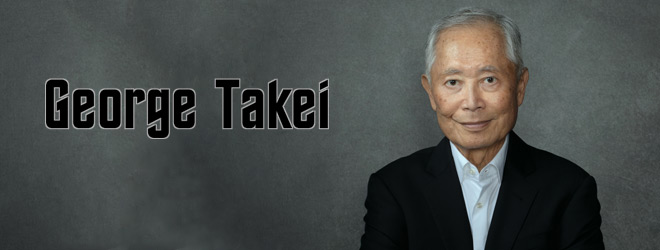
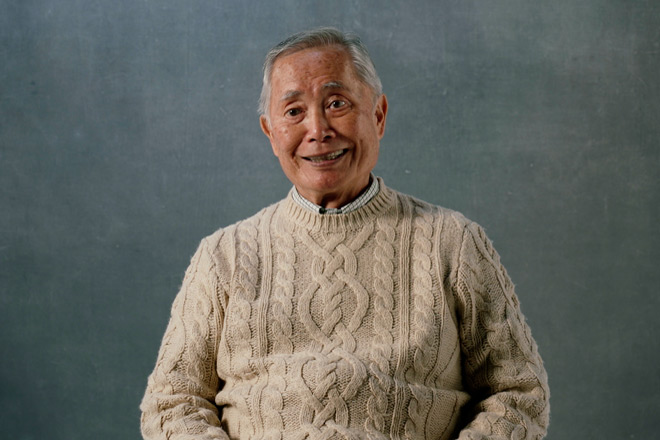
Breaking barriers for Asian Americans in entertainment, George Takei has lived an inspiring life filled with many ebbs and flows. Subjected to imprisonment in a WWII Japanese-American internment camp as a child, Takei never lost faith in American democracy through it all, going on to follow his passion for acting as a young man.
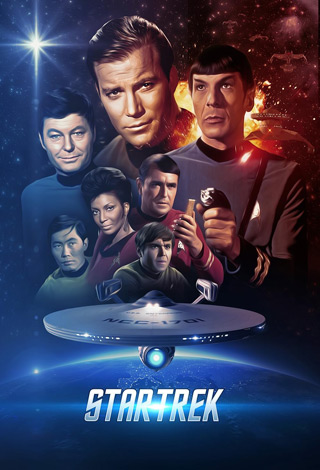
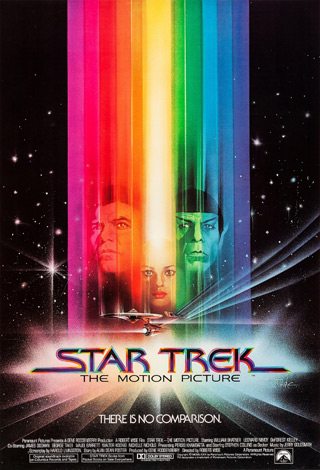
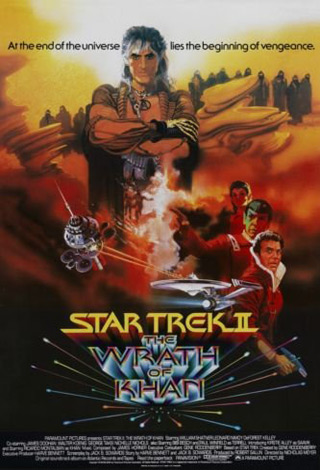
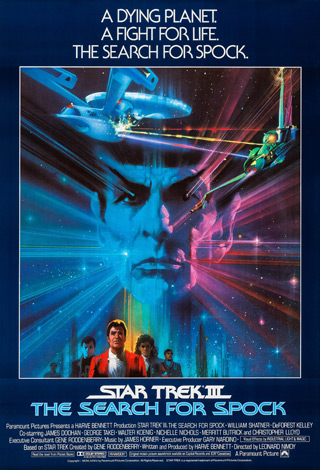
Taking on various roles in film and television in the late 1950s, in 1965, he was cast in the now-iconic Science Fiction series Star Trek as Starship Enterprise Lieutenant Hikaru Sulu. An immortal character in the Star Trek universe, Sulu is someone Takei brought to life over 30-plus years, from the original television series to six feature films.
Prolific, there is much more to Takei than his role as Sulu, because he has also lent his talents to countless other projects, both onscreen and as a voice actor. Still, this is only one side of the man who has been a passionate activist for social justice, author of numerous books, and a steadfast believer in the American dream.
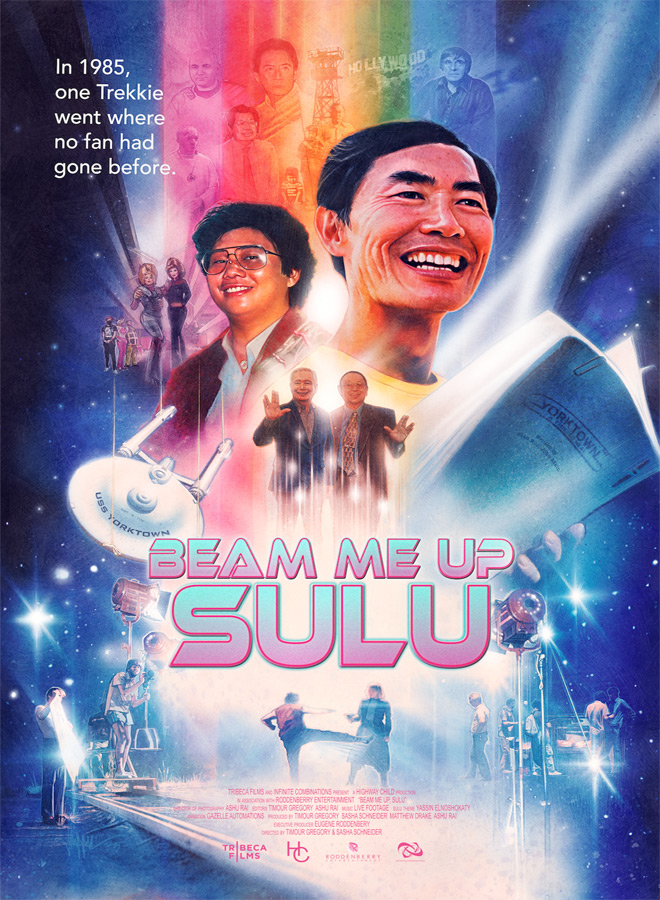
Set to celebrate his 89th birthday, George Takei still has a fire inside to bring positivity to the world, and with it, he sat down to chat about his life, the new documentary film Beam Me Up, Sulu, and much more.
Cryptic Rock – You have had a very successful, very interesting career, and you have done a lot of great things. Above all, you have lived a very interesting life. How would you describe your journey in acting?
George Takei – Well, my journey as an actor is only one part of my life. I’m an author, and I’m a political activist. I’ve even, would you believe, run for public office. But that’s not so surprising. We’ve had actors who ran for president, Ronald Reagan, and an actor who ran for governor of California. Reagan was the governor of California before he became president. Arnold Schwarzenegger ran for governor of California, and he won’t be able to run for president, even if he wanted to, because he’s not an American citizen.
Cryptic Rock – It is fascinating to learn a little about your work. You have dealt with a great deal in life, too. This new documentary, Beam Me Up, Sulu, touches on a bit of your life experiences, as well as the fan film you were a part of some forty years ago, called Yorktown: In Temporary Command. This new documentary is an interesting watch, with many telling details about society and social issues, as well as the aspect of helping a student and volunteering your time to be part of their film.
George Takei – Yeah. There are many creative people who are fans of Star Trek, and Stan Woo was one of them. He was an initiative taker. He wasn’t just there, absorbed in the entertainment. He said, “I could do that.” I think that’s another unique quality of Star Trek fans – they have that, “I can do that.”
The phenomenon of Star Trek conventions began not too late in the game. I think Star Trek conventions began after the first season of the television series. This Asian-American kid said, “I can do that.” He had an indulgent father, so he collected his friends who knew something about filmmaking. He got together with a writer friend and put together a script. They decided to make their own Star Trek movie.
That’s the unique thing about Star Trek fans. They’re initiative takers. They’re not just people who become fans and enjoy the show. They take the show they enjoyed as a stimulus and inspiration, and say, “I can do that.” When he approached me, I was a political activist. Stan had a cousin who ran for a seat on the Los Angeles City Council, and I attended a fundraising event for him. That’s where he came up to me with a glass of red wine and his hand and said, “I’m a filmmaker, an amateur, but I’d like to do a Star Trek film. And would you be in it? I won’t be able to pay you.” I was taken by his initiative first of all. Fans are usually so odd that they just want your autograph and to be near you. I was really taken by his initiative-taking and his leadership in organizing a team to make this film. I said, “Yes.” And I didn’t think that was an unusual thing. I wanted to encourage young people to do their thing. And Stan’s thing was that he was a Star Trek fan and wanted to make his own Star Trek movie. That’s how this began.
I really think we are blessed by fans who are inspired not only by what Gene Roddenberry created, but also by the inspiring concept he began with. They felt that they could participate in that, and so I agreed. That was the beginning of this fan film. The documentary is Beam Me Up, Sulu, after my character’s name in Star Trek. It’s really amazing.
Cryptic Rock – It’s actually very inspiring that a student was able to do what he did. It is inspiring to hear this story because it gives young creators a chance to go out there and maybe do something they didn’t think they could do otherwise.
George Takei – Exactly. That’s what doers do. Star Trek fans are doers, and they appreciate Star Trek’s philosophy. Gene Roddenberry thought about how people coming together from their diversity, and recognized that diversity is a magnetic force. People are different, yet they’re attracted to one another despite their differences. Star Trek is that.
Gene Roddenberry’s philosophy was that, in the future, the 23rd century, we would have advanced enough so that we would find our strength in our diversity, a person with these talents, a person with this vision, a person who can do this mechanical thing. And that’s how society becomes better. Also, though, we have within us the darker aspects of humanity: greed, jealousy, and a hunger for power. He wanted a society that recognizes that. And by the 23rd century, we would find a positive in our society and build that Star Trek community, the Starfleet community on the Starship Enterprise.
Cryptic Rock – It really was very forward-thinking. The stories of Star Trek still resonate today. Much like The Twilight Zone, those stories were also very topical about society and remain profound all these years later. It is a testament to the writing of a series like Star Trek.
George Takei – Well, we haven’t advanced too much now. Again, I mean, today, we see that dark, evil, authoritarian aspect of our society coming to the fore. Just look at what’s happening in Minneapolis. Do I need to see anymore? Here in New York, we have a place called Stonewall where the LGBTQ movement began. There’s a small triangular vest-pocket park right in front of Stonewall that became a small national park. There was a flagpole flying the rainbow flag. Recently, that flag disappeared suddenly in the dark of night. The Greenwich Village community was in an uproar. As a matter of fact, the LGBTQ community was in an uproar. The congressman from that area led the effort to put the flag back. I don’t know what’s going to happen beyond that.
We live in turbulent times now, and the darker forces of humanity are coming to the fore, whether in Minneapolis or in Greenwich Village, New York City. So the premise of Star Trek in the 23rd century is really very relevant to our times today.
Cryptic Rock – Yes, the concepts of Star Trek certainly resonate in present-day society. To your point about what’s going on in the world today, the division is troubling to say the least. So much so that many lose hope for a better tomorrow, but we have to remain positive.
George Takei – Hope is absolutely essential, but also confidence that what we base our hope on is going to prevail. Gene Roddenberry coined the acronym IDIC: “Infinite Diversity in Infinite Combinations.” When the positive aspects of that diversity come together and work together, what we’ll have is a much more engaging, much more vibrant, interesting society, where culture will flourish. Research and invention will flourish, making our society vibrant, rich, and engaging.
Be mindful of that darker aspect in our humanity; chaos can take over. I have absolute faith in the better, brighter, positive aspects of humankind. And getting those people together, we will ultimately overcome.
Cryptic Rock – You are right, positivity is essential. Beam Me Up, Sulu touches on the context of many of the things we are discussing. It also goes into what you went through as a Child as a Japanese-American detained during World War II. A horrible time, you and your family overcame it all. You triumphed and found success.
George Takei – Not just me, but the Japanese-American community. Despite being seen as an enemy, they had no facts or evidence. We had absolutely nothing to do with Pearl Harbor other than look like who we are, and we were incarcerated for that. But despite that, they took everything from my father’s business to our home. Everything was taken or sold at rock-bottom prices. We were literally stripped naked and put into these prison camps. Yet we were the ones who had faith in the democratic system and in justice, despite the fact that it turned against us. They came down with a loyalty questionnaire. Can you imagine after they force you at gunpoint to leave your home, they take your home, destroy your business, and put you in these prison camps, and the Japanese-American community was broken up.
Some said, “No, I have faith in our system. We’re going to make it work.” Others said, “This is a racist country. They don’t think rationally. We’re Americans.” So the community was fractured, too. But the loyalty questionnaire was an insult on top of the injury. After they injured us, they realized there was a wartime manpower shortage.
Here are all these young men and women that they could have had because right after Pearl Harbor, Japanese-Americans, like all young Americans, rushed to their recruitment centers to volunteer to serve in the US military. This act of patriotism was answered with a slap on the face. They were denied military service, categorized as enemy aliens, which didn’t make sense at all.
Here are these people volunteering to fight for this country, and to call them the enemy and aliens. We were born here. The government went crazy with war hysteria. Yet they answered the loyalty questionnaire the way the government wanted them to. They were put into a segregated all-Japanese-American unit sent to Europe to fight. They were sent out on the most dangerous missions. Missions that were stalemated for months on end, they called them the 442nd Regimental Combat Team. They went to fight literally for their families. They fought with incredible courage. They didn’t turn around. They kept pushing and pushing. They paid a high price.
They sustained the highest combat casualty rate percentage in the US. They came back as the single most decorated unit of its size in the entire war. They were greeted back on the White House lawn by President Harry Truman, who said to them, “You fought not only the enemy, but prejudice, and you won.” Many died. The American flag that covered their coffins was brought back to their parents, a mother greeting her son’s death, receiving the American flag that covered her son’s coffin. And here is the barbed wire fence still imprisoning her. Sentry tars with men wearing the same uniform that her son wore, aiming guns at them. The craziness and the devastating pain these people went through. Yet they made American democracy work, and were mindful of its fragility.
When I became a teenager, I became very curious about the internment. I had many after-dinner conversations with my father. He often quoted me from President Abraham Lincoln’s Gettysburg Address. Our government is a government of the people, by the people, and for the people, saying that the people have a responsibility to make it what it is. He took me to volunteer at the Adlai Stevenson presidential campaign headquarters; that was the third time he had attempted to run for president. My father believed in him, and so we volunteered in that campaign. He never got the nomination the third time, but he said, “This is the kind of persistence that a democracy requires.” And we came back.
We did great things. The Second World War ended. The Vietnam War was another mystique, and I was engaged in the EIPJ (the Entertainment Industry for Peace and Justice) movement. We have to actively participate in making democracy what it should be because people who have evil in their minds will step in and take over. That’s what’s happening now, in Minneapolis or at Stonewall in New York.
As I said, that’s the vision that Gene Roddenberry had with Star Trek. That’s the vision we celebrate, infinite diversity in infinite combinations. That’s what attracted the fans who take that kind of initiative, their initiative, and make their own movies. That’s what democracy is. People engaging and making democracy’s ideals work.
Cryptic Rock – The stories you tell are very startling. A lot of things have happened in history that we all need to learn about, so they do not repeat themselves. Again, turning back to your career, you pushed forward through everything. It can be hard for someone to become bitter and angry and fall into darkness, but you did not. Was that a challenge?
George Takei – We see it right before our eyes. I mean, all the people of Minneapolis that are standing up and being killed by these goons, masked goons that are supposed to be representing this so-called president of the United States. I mean, he is the dark aspect of democracy. It’s not a democracy of the people.
He’s a person whose only concern is his ego. The tunnel that’s being built to connect New Jersey to Manhattan is absolutely essential. Last week, one man stopped it. No more funding, and 1,000 people who were working on it are unemployed. The project being stopped will raise the cost of revving up all the machinery again. This man, who stopped it, said, “He’ll give the funding if they name Madison Square Garden after him and Dulles Airport after him.” Then you’ll fund the project. Madness and people who know better, people who think rationally, and people who think positively are not going to take this, and that’s going to end. That madman will be gone.
Cryptic Rock – We need rationality and logic, as you said. Wrapping up our discussion, what do you think are some of the most important things you have learned from your experiences as an actor and just life in general?
George Takei – Life is a learning process. I’m 88 years old. In two months, I’ll be 89. So I’ve learned a lot. I’ve contributed a lot. But with age, longevity, and time taking their toll. I’ve had foot surgery. I’m in a wheelchair, and sometimes I can’t remember certain things. Life changes as we go along, but the important thing is to know what’s important. Know what the ideals of our system are. Know that we have failed at times, but the better angels have corrected that.
As a child, I was in a prison camp, two prison camps, as a matter of fact, one in the swamps of Arkansas and the other in the desolate high plains of Northern California, cold, windswept. But my father said, “This is a people’s democracy. We’ve got to engage. We’ve got to participate.” I’ve participated in many, many campaigns. I’ve learned a great deal. I maintain that more people value and are willing to contribute to and work for our democratic system. It’s a system with many proud chapters, but also chapters we can learn a great deal from and that can make us a better society.
Once again, Gene Roddenberry was someone who had that vision with Star Trek. He connected with many fans and fan films. With Beam Me Up, Sulu, I’m honored to have my character name in the title, and they are participating in the way that they feel, their strength. I hope it will inspire more people. That inspiration is desperately needed now as we enter another dark chapter in American democracy.


No comment