

It is reported that the ocean covers more than 70 percent of the surface of planet Earth. Rather astounding, there are many millions of species living beneath the water, but a select few have captured the imagination of humans quite like the shark. An awesome creature with tremendous power, it stands to reason that 1975’s Jaws struck terror into the hearts of many moviegoers. A story about a killer shark striking terror into beachgoers of a small New England town, Jaws would become a huge hit at the box office.
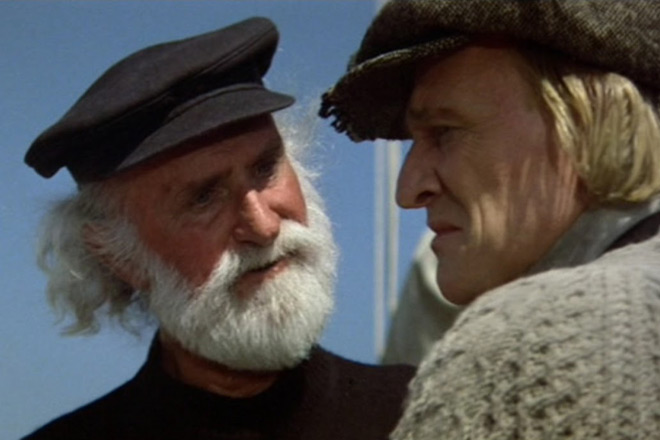
Sustaining a legacy, in truth, Jaws was just one of a slew of killer animal films during the ‘70s, joined by 1972’s Frogs and Ben and preceded by 1976’s Grizzly and 1978’s Piranha. Just a few of the titles that emerged during the era were Orca, which arrived in 1977 with a clear influence from Jaws itself.
Also known as Orca: The Killer Whale, reportedly ignited by Dino De Laurentiis (famous for producing films such as 1973’s Serpico and 1974’s Death Wish) requesting a script about a fish fiercer than a great white shark from Writer Luciano Vincenzoni. With no interest in sea life, Vincenzoni turned to his brother, who was interested in zoology and suggested a killer whale.
Something that may have been a bit of a surprise to the average spectator, considering most association killer whales with the friendly creatures seen performing tricks at Seaworld, the science shows that they are indeed the largest and most powerful animals in the ocean. Stronger, faster, and smarter than sharks; while there is no evidence that these creatures are more intelligent than human beings… some may make a case for such. Beyond this, killer whales also have a fascinating form of communication, and while it might seem far-fetched, they do feel sorrow.
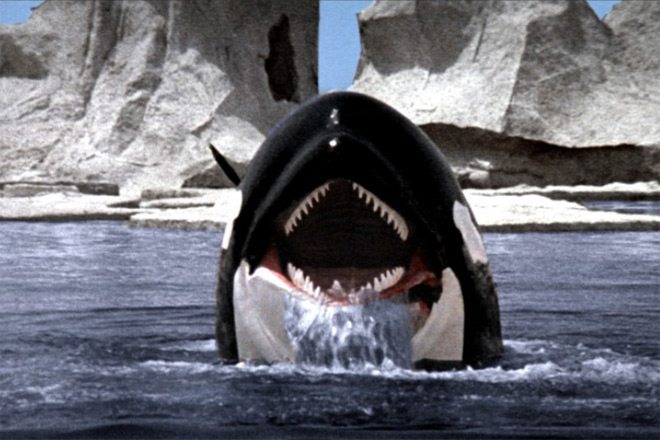
These facts considered, on the surface, Orca may seem like a rip off of Jaws, but honestly, it has a completely different mood to it altogether. While Jaws centered around the terror of a killer shark motived by hunger, Orca has a deeper emotion, following a male killer whale who tragically bears witness to his female mate carrying their unborn calf being killed carelessly by a greedy fisherman.
Now, here is where more fascinating details come into play – killer whales have excellent vision, recognize human faces, and have very good memories. Knowing this, Orca builds a story of revenge at the fins of the grieving male killer whale, seeking to make the fisherman responsible pay for what they did. Is it a story of man vs. beast? On the surface, perhaps, but if you look closer, it is much more.
A big-budget film, Orca was distributed by Paramount Pictures and hit theaters at the heart of summer on July 22, 1977. Made on an estimated $6,000,000 budget, it took in $3,500,000 in the opening weekend but overall was considered a major box office disappointment. Unfairly panned a Jaws imitation by critics, historically, Orca has been lost at sea ever since.
A sad reality, as mentioned, if you look at the story more closely, you will see that while some may call it a Horror Thriller film, Orca is really more of a Drama that points out the misgivings of human beings towards other species on the planet. The largest takeaway in Orca is that the empathic clearly favors the killer whale over the human fishing crew led by a conflicted Captain Nolan (performed by award-winning Irish Actor Richard Harris). Joining Captain Nolan, and perhaps tapping into more of his humanity, is Cetologist Rachel Bedford (played by English Actress Charlotte Rampling, known for such films as 1974’s Night Porter), who gives ample warning to leave the killer whales alone.

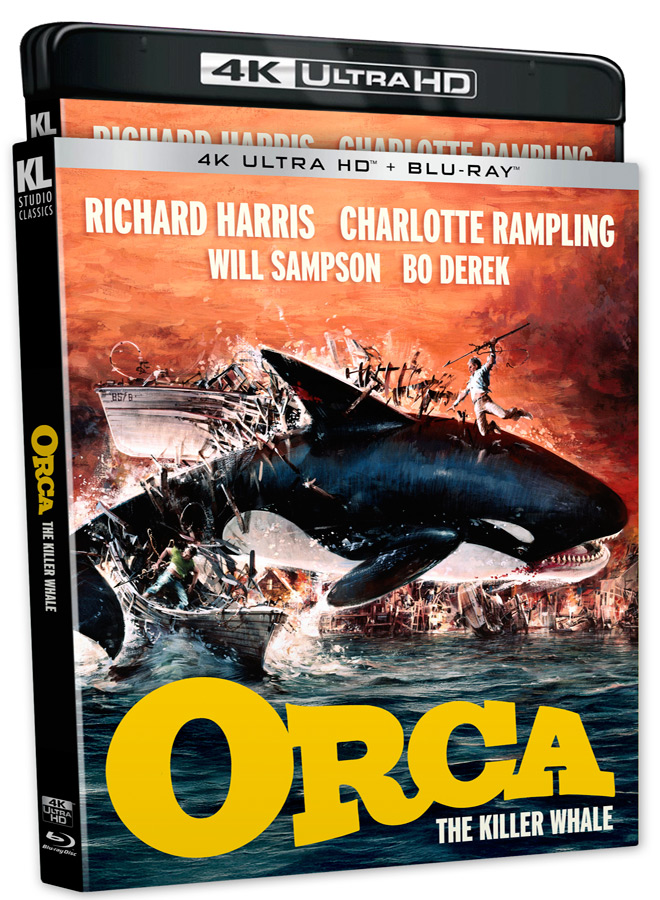
Moving at a steady pace and full of heavily emotional moments, Orca absolutely deserves a closer look even nearly fifty years later. Not entirely obscure, in the North American region back in 2004, it made it to DVD before Scream Factory released it to Blu-ray in 2020. Then, in September of 2024, Studio Canal put out a 4K Blu-ray and Blu-ray with a brand-new restoration of the film. Rather cool, now in early 2025, Kino Lorber will emerge with a 4K Ultra HD disc or Blu-ray edition.
Set for release on January 28, 2025, some might wonder what the difference is between Kino Lorber’s and Studio Canal’s releases. Well, they are pretty comparable, but Kino Lorber’s is released for North American audiences, while Studio Canal’s is an import. Understanding this, Kino Lorber’s edition comes as a two-disc set, which includes Orca on a 4K disc, as well as a Blu-ray disc in 4K Ultra HD. The transfer is a 4K scan from the 35mm original camera negative, and it looks nothing less than magnificent.
While the extras are slim, including audio commentary with film historians and the theatrical trailer, the boldest selling point of this new release of Orca is the stunning color, sharpness, and depth provided by the 4K Ultra HD treatment. Well worth an addition to any film lover’s collection, Cryptic Rock gives Kino Lorber’s 4K Ultra HD release of Orca 4.5 out of 5 stars.



)
No comment