
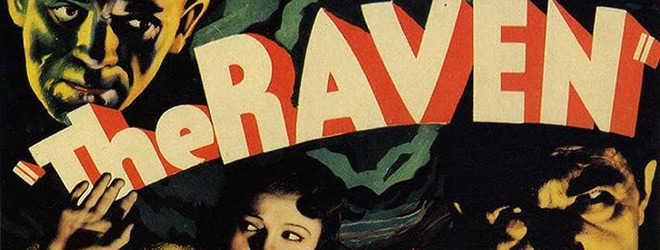
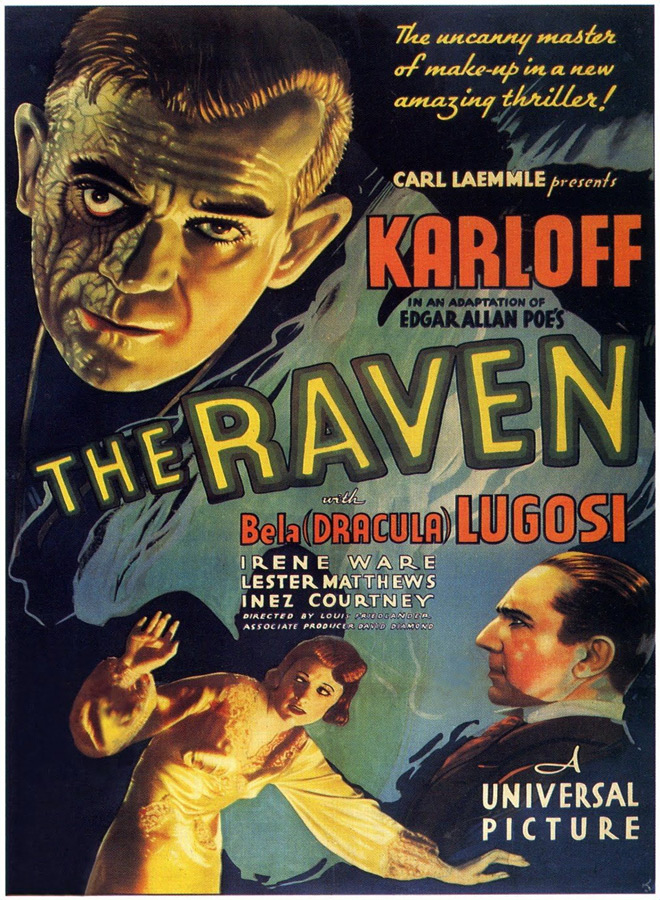
One of the most iconic pieces of American literature, Edgar Allan Poe’s poem The Raven was first published in 1845. There have been at least six versions in film, either based on, inspired by, or ‘suggested by’, like the second of the lot (only to the 1915 version), and the 1935 version. Starring the iconic Bela Lugosi and Boris Karloff, the 1935 edition turns 90 years old in 2025.
Released in July of 1935 through Universal Pictures and directed by Lew Landers, although it is not considered a Universal Monster movie, The Raven is more often an outlier because of its leads, who were regulars in the franchise. With Lugosi as Dr. Richard Vollin and Karloff as Edmond Bateman, The Raven also starred Irene Ware as Jean Thatcher, Lester Matthews as Dr. Jerry Halden, and Samuel S. Hinds as Judge Thatcher, with a supporting cast that includes Inez Courtney as Mary Burns, Spencer Charters as Col. Bertram Grant, and Ian Wolfe as Geoffrey ‘Pinky’ Burns. There were also uncredited roles, such as a dancer who performed to a recitation of Poe’s The Raven, which is a surreal moment that bridges the realms of literature and madness.

The story follows A brilliant surgeon (Lugosi) with a morbid obsession with Poe’s The Raven, and for instruments of torture grows dangerously obsessed with a young socialite (Ware) whose life he’s saved.
‘Suggested by ‘ means the film uses the psychology of Poe’s poem with themes of, at its core, obsession with grief, madness, and the haunting permanence of loss running through. In almost throwaway lines, Vollin admits he’s a widower, so we can surmise that when he is “pressed into saving the judge’s only daughter, Jean, he sees his wife in her, probably by looks, if not some personality traits. When the judge refuses to let him see her, the film uses the poem’s descent to mirror Vollin’s descent into obsession and cruelty.

From a business standpoint, Universal Pictures leveraged Poe’s name to lend prestige and gothic weight to its Horror catalog. Raven worked as part of that strategy; however, that is where the loyalty to the poem ends. It was more of a jumping-off point and aping its cultural mythos, mixing Poe’s legacy with ‘1930s Horror tropes: mad science, disfigurement, and moral decay.
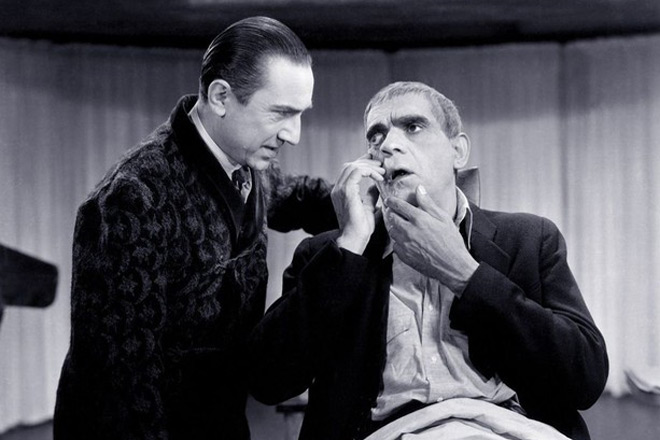
Every mad doctor needs a henchman…enter Karloff’s Edmond Bateman. Bateman comes to Vollin for reconstructive surgery he really does not need, because he is having trouble with the ladies (all he really needs is a good shave). Vollin uses this to his advantage and morbid pleasure to make Bateman ugly, so now all he can do is be Vollin’s bitch.
Shooting was from March to April, going over budget to the tune of around $115,000. Furthermore, while Lugosi and Karloff were competitive in their acting trade, it is said that the two had tremendous respect for one another and a solid personal relationship. Furthermore, the two stars had been in seven other movies together in 1939’s Son of Frankenstein and 1945’s Body Snatcher.
Interestingly, because of The Raven’s dramatic and sadistic themes, it was banned in China and the Netherlands. Searching, there are no financial numbers on the film, but it did not come close to the top earner in 1935. That said, it carries 79% and 73% on Rotten Tomatoes, with critics being mixed on it. However, general audiences consider The Raven an underrated masterpiece.
Summarizing, the behind-the-scenes drama seemed like it bled to the final cut, enhancing the threat, the horror of David Boehm’s and Guy Endore’s script. With that in mind, you can own it on DVD or Blu-ray, with the most recent edition coming in 2020 when Eureka Entertainment released it as part of its Masters of Cinema collection in the Three Edgar Allan Poe Adaptations Starring Bela Lugosi set, which was very limited in pressing, and now, hard to come by.
So, while 1935’s The Raven mirrors Edgar Allan Poe’s poem in name and psychology, it is really its own entity that is a hell of a ride, even 90 years later.



No comment