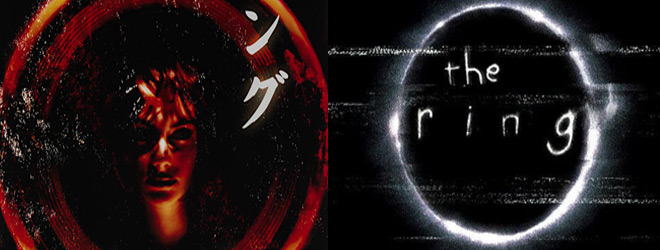
People outside Japan got snifters of J-horror through movies like 1964’s Kwaidan or the surreal nature of 1977’s House (or ‘Hausu’ to separate it from the Hugh Laurie medical drama). But while Horror fans could name European and American Horror icons off the top of their heads, like Dracula, Frankenstein, Freddy Krueger, etc, Asian ones were relatively more obscure, like the jiangshi in 1985’s Mr. Vampire and its own Chinese vampire spin-offs.
That is, until 1998’s Ring (or ‘Ringu’ as it is better known). Based on Koji Suzuki’s 1991 novel, and directed by Hideo Nakata (L: Change the World 2008, Chatroom 2010), the movie introduced the world to Sadako (Rie Ino: Inugami 2001), the vengeful spirit (‘onryo’) that curses the living via a VHS tape. If they watch it, they will have just seven days left to figure out how to save themselves. Otherwise, Sadako will come back for them and finish them off. People think she is an urban legend, until a group of friends who saw the tape died at the same time in different places.
Reiko (Nanako Matsushima: Whiteout 2000, When Marnie Was There 2014) and her ex-husband Ryuji (Hiroyuki Sanada: Twilight Samurai 2002, Shogun series) spend much of their time investigating who Sadako was and how she formed her curse. Even with their lives on the line, things only get more tense when their son, Yoichi (Rikiya Otaka: Musashi series, Kamen Rider Agito series), also watches the video and is cursed, forcing them to find answers fast. It adds an extra layer of suspense to a movie that, while low in overt shocks- no outright gore or hacking flesh- keeps the viewers’ nerves on edge.
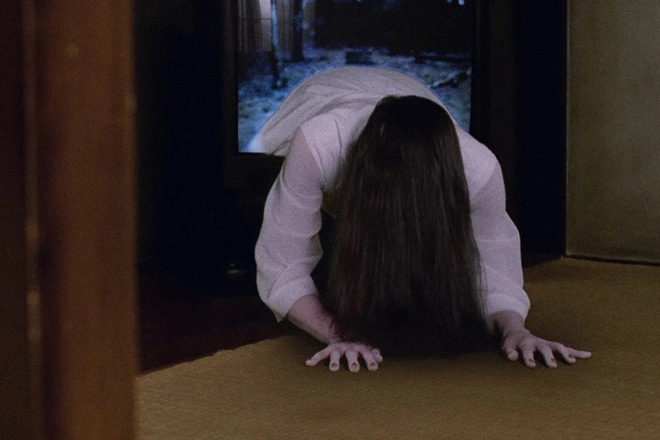
It also helped Ringu launch a boom in J-horror flicks, as many more vengeful ghost stories followed in its wake. Sadako’s rival Kayako made her cinematic debut with 2000’s Ju-On: The Grudge. Nakata adapted another Koji Suzuki story (one that already featured a divorced single parent) for 2002’s Dark Water. While 2005’s Noroi: The Curse mixed Ringu-style shocks with found-footage horror. Even 1999’s Audition– a ghost-free tale of love gone wrong- only got made due to Ringu’s success.
Much like Sadako’s curse, it began to spread and managed to leave Japan’s shores. Korea was technically the first nation to remake the movie with 1999’s The Ring Virus, where they combined elements from Ringu with bits from Suzuki’s novel, including the revelation that Sadako (or Eun-Suh in TRV) was intersex, and that she was killed because her doctor discovered that fact while trying to assault her.
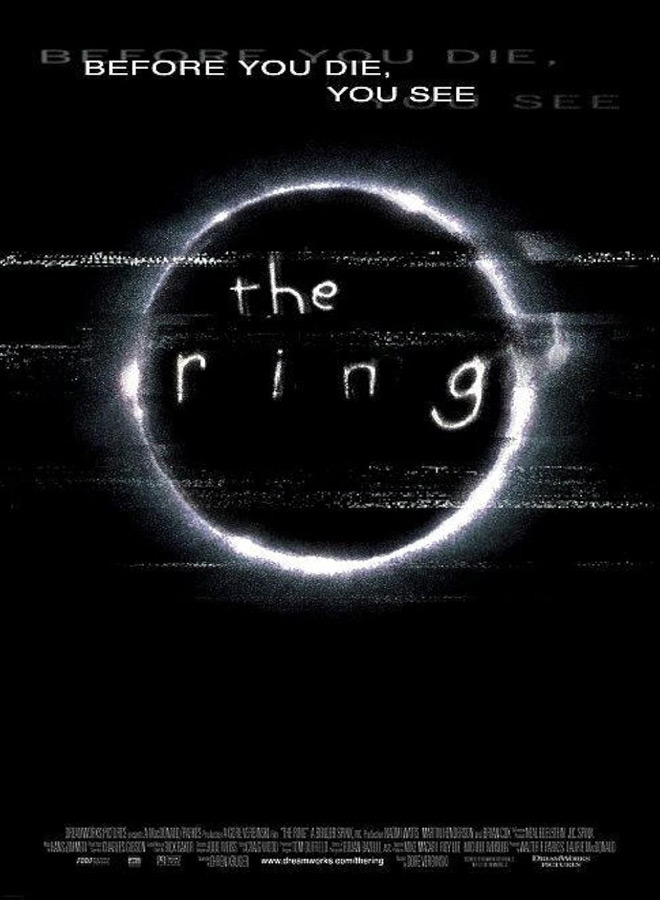
But the best-known remake is the 2002 American version, The Ring, which came about when Walter F.Parkers (WarGames 1983, Men in Black 1997) sent Director Gore Verbinski (Pirates of the Caribbean 2003, Rango 2011) a VHS tape of the movie in the post. He watched it and got into it, saying, “It’s a simple premise but not exactly a ‘studio picture’…it’s both pulp and avant-garde.” Distributor Dreamworks Pictures agreed to start production, despite neither Verbinski nor the studio having a script at that point.
Eventually, Ehren Kruger (Arlington Road 1999, Top Gun: Maverick 2022) and an uncredited Scott Frank (Out of Sight 1998, Logan 2017) worked out a draft that, for the most part, followed the Japanese movie’s beats. It is also about a divorced couple, Rachel (Naomi Watts: Mulholland Drive 2001, Birdman 2014) and Noah (Martin Henderson: Flyboys 2006, Smokin’ Aces 2006), investigating a cursed videotape that threatens to kill them, and their son Aidan (David Dorfman: The Texas Chainsaw Massacre 2003, Drillbit Taylor 2008), in seven days. Their trail leads them to an island, where they learn of a psychic girl named Samara (Daveigh Chase: Spirited Away 2001, S. Darko 2009), her fate at the hands of her adopted family, and their attempts to break her curse.
The remake came out in October 2002 and became a sleeper hit, as its advertising campaign was one of the first to go viral on the internet. They made clips from their cursed tape available online, which freaked people out enough to share the links with their friends, who would pass them along to others in their circles, and so forth. Then, once they found out they would be in a movie, they would (hopefully) go and see it. It was a pretty impressive move for an age before YouTube, TikTok, and social media.
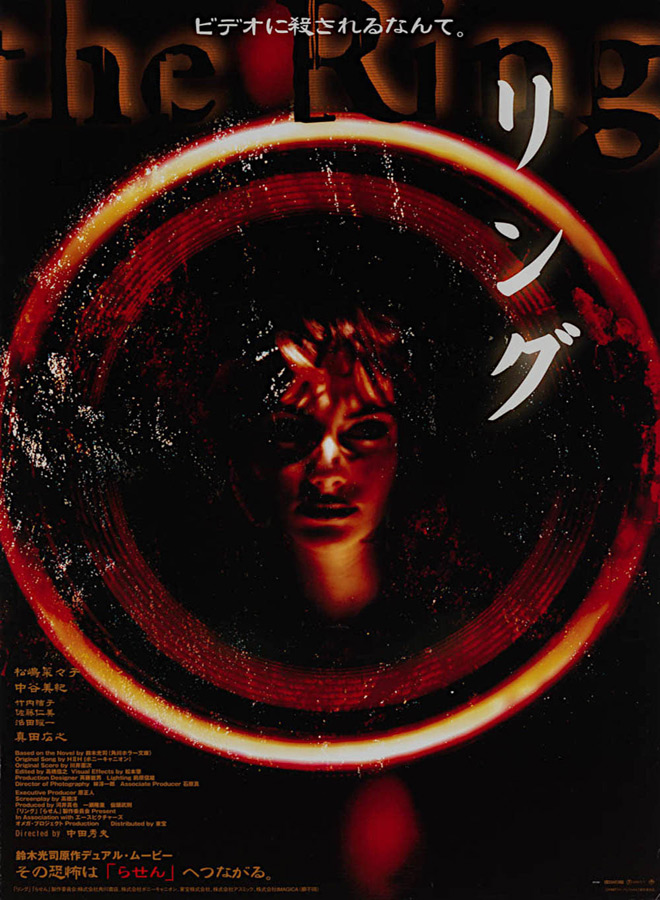
It also inspired a similar boom in Asian Horror remakes, as Ju-On, Dark Water, and the 2002 Sino-Thai Thriller The Eye, among others, also got the Hollywood treatment to varying degrees of success. 2004’s The Grudge (with an eerily similar poster to Ringu) caught on with viewers better than the critics, while 2008’s The Eye, with Jessica Alba (Sin City 2005, Machete 2010), didn’t impress either viewers or critics.
The Ring is arguably the best of these remakes, as it followed Ringu’s lead while doing its own spin on things. Rachel is a testier figure compared to the more passive Reiko, and the tension between her and Noah is shown through more outright hostility at the start than Reiko and Ryuji’s awkward cold shoulders. The former is more in-your-face about its domestic drama, while the latter makes its viewers read the room.
The same could be said for its scares as well. Ringu’s cursed tape is more eerie and off-putting, with its crawling people, cloaked figures, and blurred faces. All set to scraping strings and a gnat-like buzzing that digs into the viewer’s skull. They play into the movie’s plot better, too, as each sequence offers a clue for the viewers, some of which were copied over to The Ring’s tape, like the switching mirrors and shots of the well.
The Western version provides its own clues, though most of the imagery feels freaky for the sake of being freaky. Teeming maggots, severed fingers, extra footage of Samara’s mother compared to her Japanese counterpart, and more. It is more shocking, though it lacks the mystery of Ringu’s tape, so it does not linger in the mind as much. The Japanese one leaves viewers wondering what the hell they just saw, while the American one distracts them a bit with its mouth-ropes and burning trees.
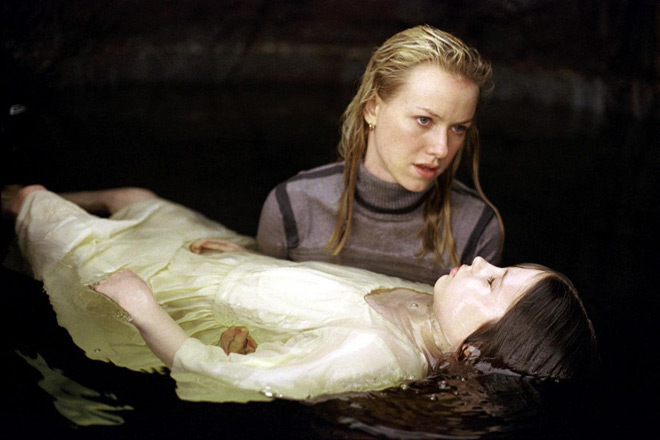
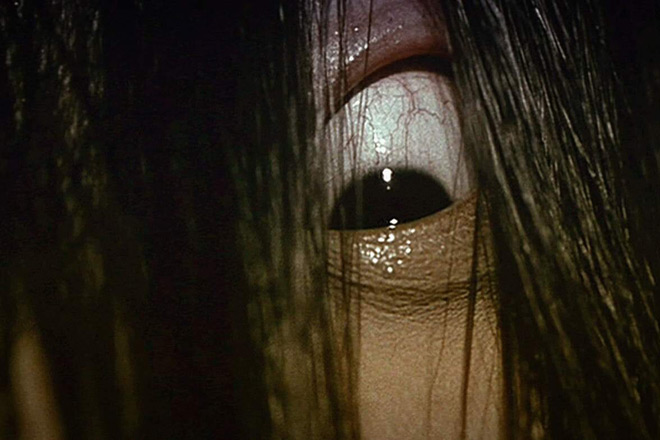
But many viewers do prefer what Samara does to her victims in The Ring than Sadako’s M.O. in Ringu. Sure, the close-up of Sadako’s bloodshot eye is more visceral and horrifying than Samara’s moody mug. However, Samara’s victims were left disfigured, leaving viewers wondering what on earth she did to them. Sadako gave them the negative-filter flash and left them as rictus figures, frozen in fear. Grim, though not exactly grisly.
Samara’s backstory also received her own touches over Sadako’s, for better and worse. She had a sympathetic edge that the movie Sadako largely lacked, as Samara was a young girl struggling to control her powers, which admittedly is a little derivative. Young girls with powers pushed to the edge had been done before in Carrie, Firestarter, and their movie adaptations. However, she had one quirk that made the movie notorious.
The movie had a little subplot where Samara’s foster mother Anna (Shannon Cochran: Star Trek: Nemesis 2002) bred horses, and their braying and rustling annoyed Samara so much that she psychically drove them to gallop off a cliff. A scene that was foreshadowed by horses appearing in the cursed tape, and another sensing the curse on Rachel, and trotting its way off the ferry, into the ocean, then into the ship’s propeller. The remake was too heavy on the blue filter, but there had to be better ways to add some blood than a suicidal Seabiscuit.
Ringu maintained a more consistent tone, though it has been criticized for trimming and altering many details from the 1991 novel. It made Sadako a less sympathetic figure and made her story more of a straightforward horror thriller compared to the book’s psychosexual tones and reproductive themes. But in turn, the movie’s more mystical-technological take on the curse did not strain credulity as much as a literal virus that induces airway-blocking tumors in the novel would have.
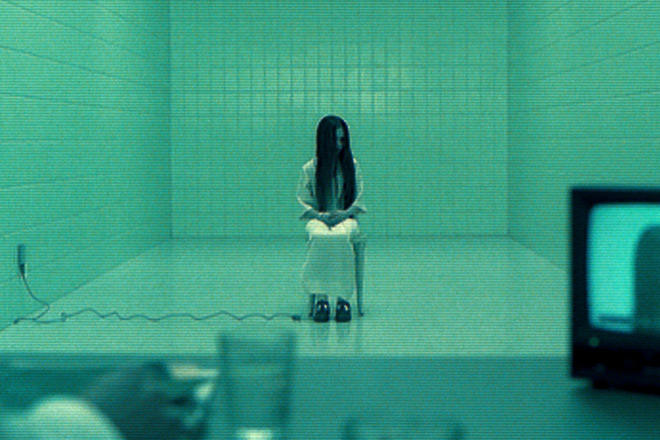
Though what made Sadako last longer than Samara was not The Ring’s flaws, as it went on to outperform Ringu at the box office, and still works as an effective horror remake. It is likely down to the sheer number of follow-ups. Samara returned in 2005’s significantly weaker The Ring Two (though Roger Ebert preferred it to the first film), then went dormant until 2017’s Rings, which sent her back to the well when it underperformed.
Whereas Sadako appeared in 9 different movies, each with conflicting continuities. Ringu got a direct sequel in 1999’s Ringu 2, a 2000 prequel Ring 0: Birthday, and a third entry in 2019’s Sadako KOL. 2022’s Comedy Horror take on Sadako DX follows Ringu but ignores all its sequels. 1998’s Rasen appears to follow Ringu, but it is actually an adaptation of the novel’s sequel, Spiral. It was not received well, yet it got its own sequels in 2012’s Sadako 3D and 2013’s Sadako 3D 2.
That is, without mentioning 1995’s Ring: Kanzenban, the different TV miniseries and manga, and 2016’s Sadako Vs Kayako, giving J-horror its own equivalent to 2003’s Freddy Vs Jason. Many of these follow-ups were weaker than both Ringu and The Ring, but they showed how much of a cultural phenomenon the TV-dwelling ghost became in her home country.
Though as humble as The Ring’s reception was by comparison, it is a decent remake in its own right (sea-horse aside). It is not flawless, though it holds up much better than the other J-horror remakes that came out in its wake, and spread the terror of cursed AV tech to a larger audience. One that still lasts to this day through analog Horror, as it also delves into the fear and monstrosities that could lurk in old media.



No comment