

This month in horror movie history, The Brood debuted in theaters in the USA on Friday, May 25, 1979.
When The Brood was released forty-six years ago, Director and Writer David Cronenberg (Scanners 1981, The Fly 1986) was not yet the Horror legend he is considered today. The Brood is a psychological Body Horror film that explores themes of trauma, family dysfunction, and motherhood. The story follows Frank Carveth (Art Hindle: Invasion of the Body Snatchers 1978, Black Christmas 1974), who becomes concerned about his estranged wife, Nola (Samantha Eggar: The Collector 1965, Doctor Dolittle 1967), undergoing radical psychotherapy under the mysterious Dr. Hal Raglan (Oliver Reed: Gladiator 2000, Oliver 1968). The therapy manifests her repressed emotions as lesions, leading to the creation of grotesque, childlike creatures that act out her rage on those who appear to threaten her.

At first, the plot feels disjointed, with two seemingly separate narratives: one following a series of gruesome, inexplicable murders and the other focusing on the bizarre therapy sessions of a deeply disturbed woman. As the story progresses, however, these threads intertwine, revealing the horrifying connection between Nola’s therapy, her emotional state, and the physical manifestation of her trauma. Arguably, leaving the audience confused makes for a big payoff – an iconic reveal of what Nola has become.
Like most Body Horror, the real story lies beneath the surface, considering the deeper themes Cronenberg explores. During the production of The Brood, David Cronenberg navigated a bitter divorce and his ex-wife’s involvement in a cult-like therapy group, making this film a profoundly personal story. Notably, in the 1970s, there was a growing movement for holistic medical care and New Age therapies, which promised emotional and spiritual healing through unconventional methods. This cultural shift toward alternative therapies is directly reflected in the film’s depiction of Dr. Raglan’s radical psychotherapy.
The film delves into the lasting impact of dysfunctional family dynamics, focusing on how cycles of abuse and neglect can reverberate through generations. Nola’s troubled upbringing, marked by abusive and neglectful parenting, serves as the foundation for her psychological unraveling and emotional instability. Cronenberg acknowledges how dysfunction within families creates trauma that reverberates across generations by manifesting this as lesions on Nola, which then develop on Candice.
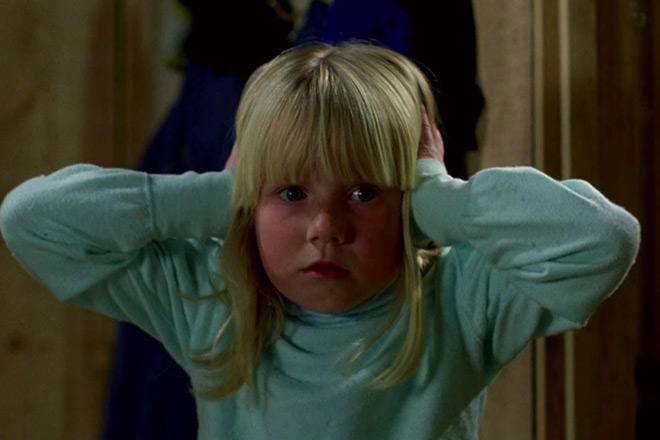
The physical manifestations of Nola’s anger are terrifying—creatures that initially resemble human children, until you notice their grotesque, unnatural features. Their pale, expressionless faces, misshapen bodies, and eerily robotic movements strip away any semblance of innocence, turning them into chilling embodiments of Nola’s suppressed rage. These creatures act as extensions of her fury, carrying out violent acts against those she blames for her pain. Their unsettling presence blurs the line between humanity and monstrosity, serving as a haunting reminder of the destructive power of unprocessed trauma when it takes on a life of its own.
Society in the 1970s was gripped with profound anxiety about the future, driven by political unrest, economic instability, and cultural shifts that left many questioning the stability of traditional values and institutions. This pervasive sense of uncertainty is reflected in the horror films of the decade, which often delved into themes of societal breakdown, loss of control, and the fragility of the human psyche. By 1979, more than 50% of women had jobs outside the home, and with the introduction of ‘no-fault’ divorce, divorce rates were on the rise. This shift in family dynamics, alongside the erosion of traditional roles, created a climate of emotional and social upheaval. As family structures began to fracture, the psychological toll of divorce, particularly on children, became a central issue.
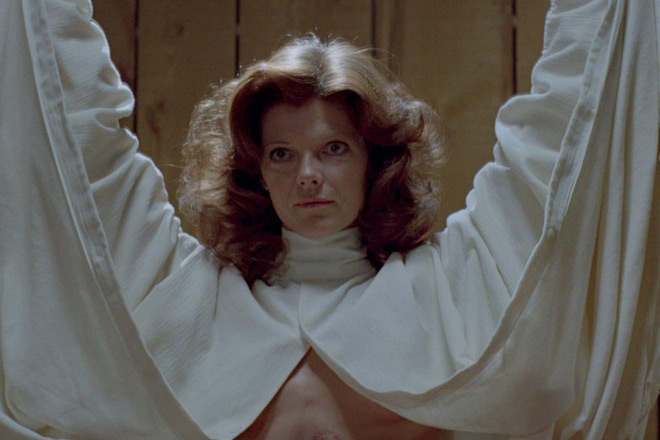
This theme of familial disruption and the fallout of divorce is a key part of The Brood. Due to wars and scandals in the 1960s and 1970s, the government and other institutions were deeply distrusted. This effect can be seen across horror films of the time, but it is particularly evident in Cronenberg’s early works. In many of his movies, institutions threaten society or characters’ physical well-being. In The Brood, the Somafree Institute of Psychoplasmics is the organization offering the new-age treatment that leads to multiple people being traumatized or murdered. In 1981’s Scanners, the organization ConSec is recruiting Scanners. In 1969’s Stereo, the Canadian Academy for Erotic Inquiry is conducting telepathy research, and in 1977’s Rabid, the Keloid Clinic for Plastic Surgery performs experimental treatments – to name a few.
Overall, The Brood was a commercial success, grossing an estimated $5 million against a modest production budget of just $1.5 million, making it a profitable film. The film has stood the test of time, with talk therapy becoming more common and open discussion of trauma across social media—the trauma theme of the film is even more relevant from that perspective. Despite its enduring relevance, we have yet to see a remake—and perhaps that is for the better.





)
No comment