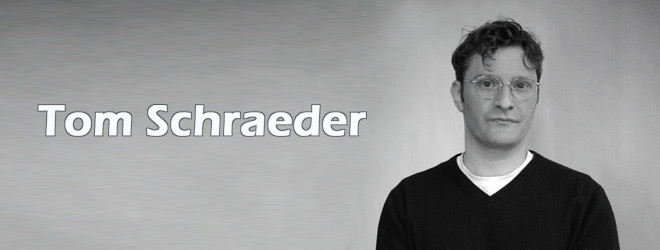
The paths we travel early on in a journey are almost certainly never the ones that take us where we are going. In all walks of life, the case for Tom Schraeder was an inherent passion for cinema and music at a young age. Something that would follow his every step —never could he imagine coupling the two into a career like the one he is currently in, as a successful composer.
A singer-songwriter and multi-instrumentalist, Schraeder has worked tirelessly over the years writing and recording music with others, and over the last decade-plus has found a niche working on hauntingly tense soundtracks. Working on the scores for films like 2018’s Hurt and 2020’s The Dark and the Wicked, both of which earned him nominations, he continues to find new and exciting projects.
Jumping to 2025, he worked on the soundtrack for two standout Horror flicks with We’re Not Safe Here and the buzzworthy Vicious. Vicious, starring Dakota Fanning and premiering on Paramount+ on October 10, 2025, is a tension-filled film where Schraeder’s music extraordinarily adds to it all. Excited about his past and future works, Tom Schrader sat down to discuss the process behind scoring, his time working on Vicious, plus more.
Cryptic Rock – You have been active in music for many years now. Finding success in soundtrack composition, what led you down this path?
Tom Schraeder – A lot of variables led me into the film world from solely pursuing a music career for nearly two decades prior. My love for film began very early on. As a toddler, I was already auditioning for movies, and I began writing screenplays at 10. It started as a hobby, but one that’s lasted even longer than I’ve been playing music, which I’ve been doing for 30 years now. What I’ve always connected with about screenwriting is how laconic and lyrical its format has to be.
As my music career began to take up more of my time, film naturally fell to the side. After years of recording, playing shows, and touring, I eventually took a step back and started writing songs for myself again, just to get grounded and reconnect with music as a passion rather than simply a profession. I went back to bartending and reconnected with a friend, Producer & Director Sonny Malhi (known for The Lake House (2006), The Strangers (2008), and The Dark and The Wicked (2020)), who asked me to write an original song for a film he was directing, which led to me co-composing the score for his next feature, 2018’s Hurt.
Shortly after, I was introduced to Bryan Bertino. We hit it off immediately, and he asked me to score The Dark and the Wicked. I wrote many of the film’s themes based solely on reading Bryan’s beautifully written script. Something just clicked, and I recognized the similarities between writing music for film and traditional songwriting. Both play with tension and release, and both require leaving space for words, or in the case of film, dialogue. Suddenly, all the years I’d spent pursuing music and experimenting with screenwriting felt purposeful. Film scoring was the dream I’d been subconsciously working towards all along.
Cryptic Rock – That is a fascinating story, and it is inspiring to see how everything came together for you. As mentioned, you have been quite busy over the last decade composing for films. Many of the movies your music has been featured in lie in the Horror genre. Are you a fan of Horror films, and what is the creative process behind writing for the genre?
Tom Schraeder – Funny enough, I was far too afraid to watch Horror films growing up. I often say that the Horror genre found me, and I couldn’t be more grateful for that. I’ve fallen madly in love with it, from the filmmaking process, the intelligent metaphors, the artistic soundscapes, and most of all, with the fans.
I’ve attended screenings at festivals like Fantastic Fest and Fantasia, and the Horror community is unlike any I’ve ever encountered. They’re immensely knowledgeable, passionate, and filled with an unmatched enthusiasm. They’re the definitive reason I love working in the genre.
As a creator, having an audience that cares that deeply pushes me to raise the bar. With every score, I make a point to respect the fans by challenging myself to avoid tropes, never take the safe route, and lean wholly into originality. It’s important to me that each film has its own sonic palette and tonal identity.
The question I get most often is whether I want to stay in Horror, and my answer is always yes. This is my forever genre. While I’d love to explore others as well, Horror is special because it amplifies an authentic kind of creative expression and freedom that many genres simply don’t.
I could keep going, but to keep it short, I’m completely Horror-obsessed.


Cryptic Rock – It is funny how we develop an appreciation and love for something over time. One of the most recent films you have worked on is the newly released Vicious, starring Dakota Fanning, which is getting quite a buzz. How did this project come about for you?
Tom Schraeder – Vicious came about through my ongoing collaboration with Bryan Bertino. Bryan sent me the script a couple of years ago, and I began writing music to the pages right away. We started developing themes early in pre-production so he could have the score during filming.
Once post-production began, I went out to L.A. and was given an office on the Paramount lot for the duration of editing. I worked side-by-side with Bryan and his incredible post-production team. It was far from conventional, but I loved it. Being just feet away from Tad Dennis (the film’s editor), our masterful Music Editor Bruno Roussel, and the wonderfully supportive Paramount Music Department made it a deeply collaborative and creative experience.
What an education it was getting to work on such a historic lot. Funny enough, many of the final themes and ideas were conceptualized while walking around the studio lot with our second editor, Steve Forner. The Paramount Spirits definitely should’ve gotten a credit on this one, given all of their haunting inspiration.
Cryptic Rock – It sounds like it was an enriching and fun experience. Vicious has an interesting plot with a great deal of tension. Some might even say it has shades of the 2022 hit Horror film Smile. What was it like creating the soundscape for this film?
Tom Schraeder –Vicious intentionally carries a deep sense of tension throughout. Bryan wanted to build a “wall of sound” that mirrors Dakota Fanning’s incredible performance. We wanted it to capture her character’s battle with anxiety as it ultimately spirals into a psychological descent.
Working with an actor as masterful and nuanced as Dakota was such a privilege. We wanted the sonic palette to reflect the same intentionality and precision that she and Bryan (along with cinematographer Tristan Nyby) brought to the film. To achieve that, we incorporated items such as wine glasses, cigarette packs, shears, and jewelry. It was all the household items she interacts with to build a soundscape around her that feels almost like an audible panic attack.
I enjoy hearing people compare Vicious to Smile, which is a modern classic in its own right! While I can see where some parallels might be drawn, the horror in each film manifests differently. Vicious is intensely personal, focusing on Polly’s inner turmoil, whereas in Smile, it feels as if the entire world is haunted by the “Smile.” Both are terrifying in their own way, but the experience of fear is very distinctive in each film.
Cryptic Rock – Excellent points. Anyone who enjoyed Smile will absolutely enjoy Vicious. It goes without question that a film without a soundtrack loses its effect. This is especially the case in Horror, because when you remove the music, a build can feel less powerful. When you are composing, do you have visuals to reference, or do you record the music solely from watching the movie?
Tom Schraeder – My process varies from director to director. Ultimately, my main job as a composer is to serve the director’s needs and wishes, which is whatever best supports their process and brings their vision to life.
I’ve been fortunate to work with several directors multiple times now, and that creates a special bond. Learning each director’s personal process is sacred. With Bryan in particular, it’s been really special. Over the years, we’ve found a rhythm that allows us to create from a deeply authentic place together.
As I mentioned earlier, I personally prefer starting to score from the script, writing themes, and building a sonic soundscape before ever seeing the visuals. I’ll then break down score logistics with my legendary score producer, Allison Wright Clark, to figure out what we’ll need to pull it off.
When the edit begins, I’ll place the music into the film and adjust accordingly, scaling up or down depending on what the picture demands. I tend to work fast and instinctively, following the same ethos I developed from producing records: Create intuitively, layer freely, and refine later. Once everything feels right with the picture and Bryan approves, we move into orchestration—ideally with the brilliant Max Mueller—to record the temp cues with live musicians and replace the earlier mockups with those live tracks.
From there, our music editors, Bruno Roussel or Joe Stockton, fine-tune everything to ensure perfect sync with the picture. Honestly, I think the music editor is an unsung hero of film scoring. I firmly believe they deserve a “music by” credit, too.
Finally, the score goes through mixing and then to the dub stage, where Bruno once again ensures that every note serves the film’s final sound. It’s a process I love.
Luckily, with a director like Bryan, the process is even more collaborative. He’s so musical and easily the most musically knowledgeable director I’ve ever worked with. I often say working with him feels less like a traditional director–composer relationship and more like being in a band, where he’s the frontman, and I’m the sideman just trying to bring his vision to life.


Cryptic Rock – That is a good analogy. It seems like everyone you work with has a unique style that you feed off. With Vicious out now, you also worked on other recently released features, such as We’re Not Safe Here. Are there any other projects you will be a part of that you can mention?
Tom Schraeder – Yes! I just finished reading one of my favorite scripts I’ve ever received, and I couldn’t be more thrilled to work on it with a dear collaborator. Unfortunately, I can’t say much more about it yet, but it’s going to be a very special project.
I’m glad you mentioned We’re Not Safe Here, which was just released in August. I’m very proud of that project and my collaboration with Co-Composer Joe Stockton. Joe has been a longtime collaborator of mine in various roles. I call him a post-production Swiss Army knife. He was also a huge part of Vicious, this time as a score technician and composer’s assistant.
I often joke that no score is complete without a bit of Joe Stockton’s magic, whether that is mixing, editing, or assisting. We’re Not Safe Here marked our first time officially co-composing together, and it was a deeply rewarding experience. He’s a pure talent and a brilliant mind who elevates everyone around him.
That soundtrack was also special because I got to write three original songs for it. One of which, “Save Yourself,” is hummed by the lead actor, Hayley McFarland (from 2013’s The Conjuring), in the film as a recurring motif. That kind of integration between song and score is something I’d love to explore more in the future.
Cryptic Rock – Hopefully, we will learn more about that project you mentioned. It sounds like the working collaboration for Joe Stockton on We’re Not Safe Here will lead to future projects. You obviously have your own inspirations. What are some of your musical influences?
Tom Schraeder – Like most artists, my early inspirations varied and ranged from Elvis, Springsteen, The Beatles, Tom Petty, Roy Orbison, The Chi-Lites, Paul Westerberg, Earth, Wind & Fire, James, Oasis, Radiohead, Velvet Underground, and Wilco. While the list could go on, I’ll spare you the time.
As I began to focus more on scoring, my musical rotation expanded to include Bernard Herrmann, Jonny Greenwood, Wendy Carlos, Clint Mansell, Haruomi Hosono, John Williams, and Tchaikovsky—also, György Ligeti and François de Roubaix.
It was working with my great friend and longtime collaborator, the late Saxophonist Mars Williams, that helped me discover my sound more than any single artist or band. He taught me that the world around us is an instrument, and that anything and everything can make music.

Cryptic Rock – It sounds like you have a great mix of influences. Music certainly is all around us. It could be one of the most unifying forces of all. As a songwriter, there are often many sides to your creativity. Do you find composing soundtracks a complete fulfillment of each side, or do you have aspirations to work in a different frame, such as solo artist, or with a band?
Tom Schraeder – Those years spent as a songwriter, recording artist, producer, and bandleader were pivotal in shaping my musical voice. Collaborating with incredible musicians, producers, and engineers in these capacities for so long was both a cherished chapter and a deeply educational experience.
Having made over 30 albums before moving into film, I learned the importance of differentiating genres, experimenting with instruments, and trusting my gut. It guided me to create from an honest, instinctual space that would connect more with audiences, rather than trying to predict what listeners wanted to hear. That ethos directly carried over into scoring.
For instance, when I was scoring The Dark and the Wicked, I remember writing the main melody while singing and playing guitar along with the script. That’s when I realized that if I simply removed the lyrics, an instrument could carry that top-line melody just as my voice once did. From there, I began treating instruments like extensions of the human voice.
That’s exactly how I approach scoring: playing with tension and release, leaving room for dialogue, giving space for nuance, and treating every instrument as a distinct personality within the story.
All that said, I still love writing original songs for films and co-writing with other artists just as much as ever, perhaps even more than I did years ago.
Cryptic Rock – It is delightful to hear how passionate you are about the music. It indeed shows in your body of work as a composer as well. Last question. Since you said you have developed an affection for Horror, what are some of your favorites? Also, what are some of your favorite movies in general?
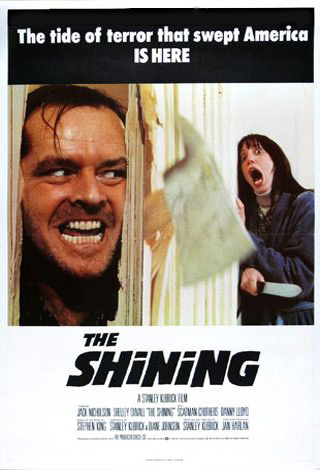
Tom Schraeder – My top five Horror films would have to be The Shining (1980), Rosemary’s Baby (1968), The Strangers, Psycho (1960), and The Texas Chainsaw Massacre (1974). Some of my favorite other films, in no particular order include Eternal Sunshine of the Spotless Mind (2004), Eyes Wide Shut (1999), Vertigo (1958), Network (1976), Nashville (1975), The Apartment (1960), The African Queen (1951), Speed (1994), Putney Swope (1969), Pulp Fiction (1994), Magnolia (1999), Notting Hill (1999), Before Sunrise (1995), Goodfellas (1990), Taxi Driver (1976), One Battle After Another (2025), Ferris Bueller’s Day Off (1986), and Dumb & Dumber (1994).



No comment