

Feelings and experiences explored through the innate power of music have been a popular theme in film this year, with films such as Sinners and K-pop Demon Hunters being extremely successful with audiences. Now, to round off the year, comes another film that uses a musical backdrop to explore the coming-of-age of one teenage girl.
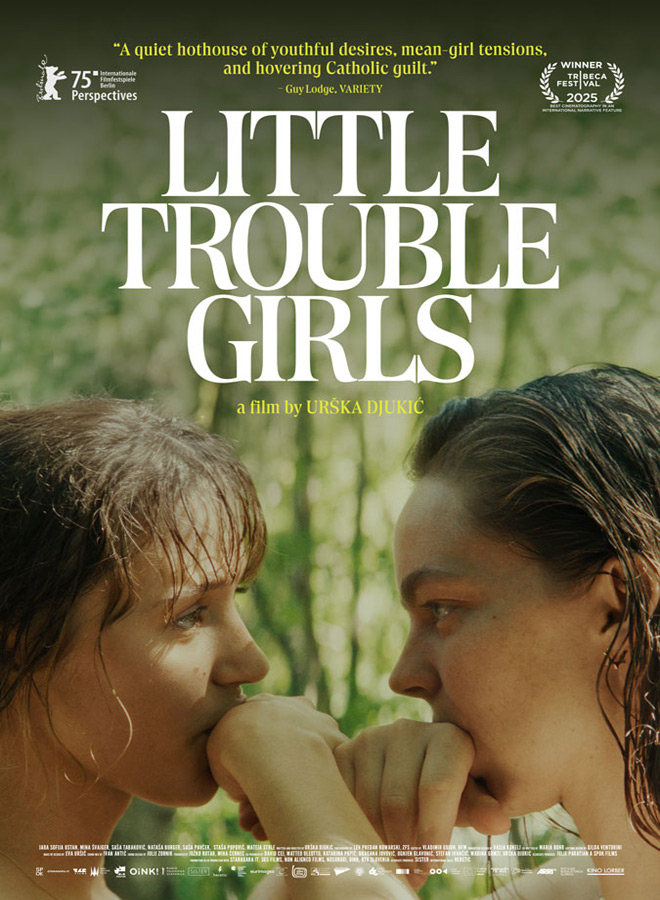
Co-written and directed by Urška Djukić in her directorial debut, Little Trouble Girls had its premiere at the 75th Berlin International Film Festival. It has also been selected as Slovenia’s entry for Best International Feature Film at the 98th Academy Awards. Furthermore, Kino Lorber released it exclusively at the IFC Centre in New York on December 5, 2o25, before releasing it in Los Angeles at Laemmle’s Monica Film Centre on December 12th, with a national rollout to follow.
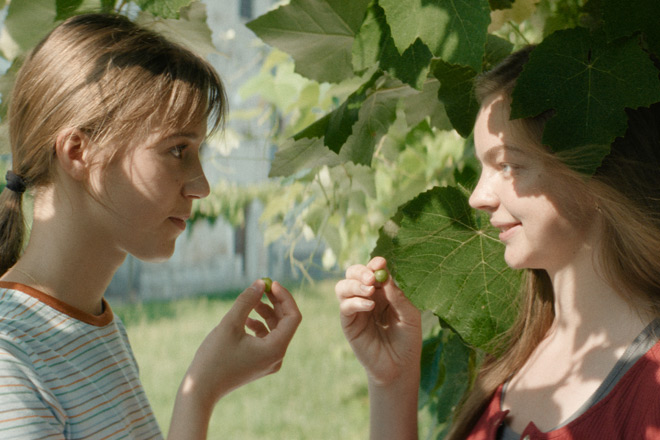
Something different, Little Trouble Girls follows sixteen-year-old Lucia (Jara Sofija Ostan in her debut). Lucia is the newest member of her Catholic school’s all-female choir. With a perpetually asleep father and an overbearing mother, sheltered Lucia is shy and quiet. From her first rehearsal, Lucia is fascinated by Ana-Maria (Mina Švajger, also in her debut) with her bold red lipstick and worldly manner, and the pair become unlikely friends. When the choir takes a memorable trip to Cividale del Friuli to stay at a nunnery to rehearse for an upcoming performance, their friendship intensifies in ways that both confuse and excite Lucia.
Taking its title from a Sonic Youth song, Little Trouble Girls juxtaposes its Rock-influenced name with the choral holy music the girls learn and perform. This music is taught to them by their choirmaster (Saša Tabaković: Inventory 2021, Whites Wash at Ninety 2025), whose ambition and passion turn into cruelty and severity when Lucia makes the mistake of confiding in him. Throughout, the holy music and its teachings represent a form of repression and the authority figures’ control in Lucia’s life. Later, when Lucia listens to a different genre of music, she becomes more alive and freer in a way she hasn’t been previously.
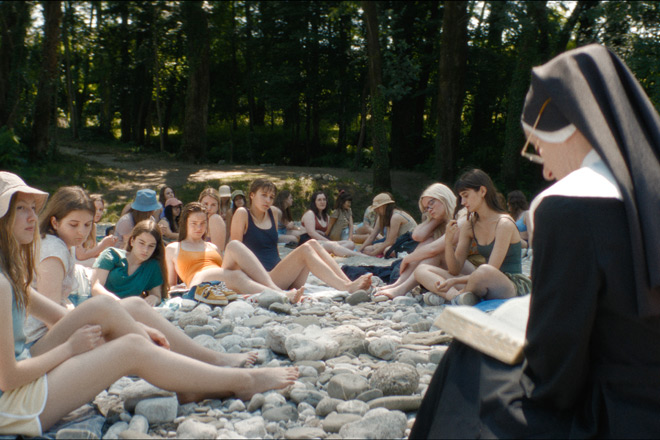
Overall, Little Trouble Girls is shot wonderfully, making every inch of the frame feel intimate and inviting. The sound design is also used to significant effect, utilizing ASMR to evoke all the senses in the audience. In moments, this feels like a film you can smell, touch, and taste as well as see and hear.
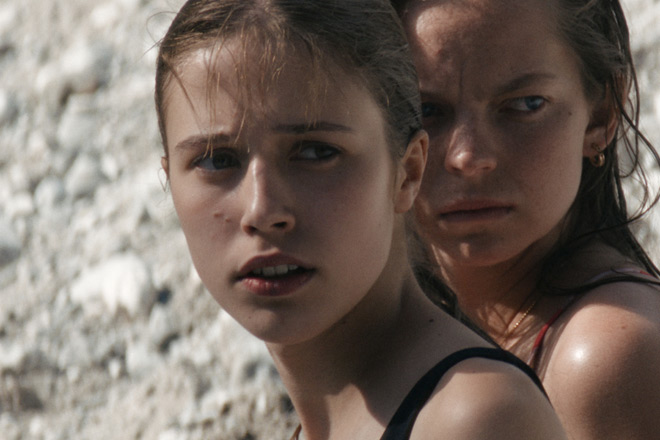
Furthermore, the cast is also powerful. As a newcomer, Ostan is astonishingly good, showing so much through microexpressions and wide eyes, whilst Švajger perfectly captures the vivacious, popular girl that everyone feels like they knew at least one of growing up. Meanwhile, Tabaković can certainly take his place amongst cinema’s fellow abusive music teachers.
Given that this is also Djukić’s debut, Trouble Little Girls is extremely impressive overall. A poetic coming-of-age story exploring both faith and queerness, this quiet, unfussy film is very effective. Djukić is without a doubt a filmmaker worth looking out for. That is why Cryptic Rock gives Trouble Little Girls 4 out of 5 stars.



)
No comment