
Chinese cinema has produced its fair share of classic flicks. With just a handful of movies before his untimely death, Bruce Lee revolutionized action movies by bringing kung fu into style. John Woo went in a different direction, bringing in his own style of ‘heroic bloodshed’ in the likes of 1986’s A Better Tomorrow and 1992’s Hard Boiled. In contrast, viewers who preferred emotional drama to fisticuffs had the likes of 1994’s Chungking Express, 2000’s In the Mood for Love and 2007’s Lust, Caution.
If they did not have icons like Lee or famous directors like Woo or Ang Lee behind them, they created stars out of the likes of Jackie Chan, Chow Yun-Fat, Takeshi Kaneshiro and more. So, it might be surprising to learn that a little Comedy Horror flick with no internationally-known names on-screen, and its biggest name- Sammo Hung- staying behind the scenes, could rival them in laughs, chills and spills.
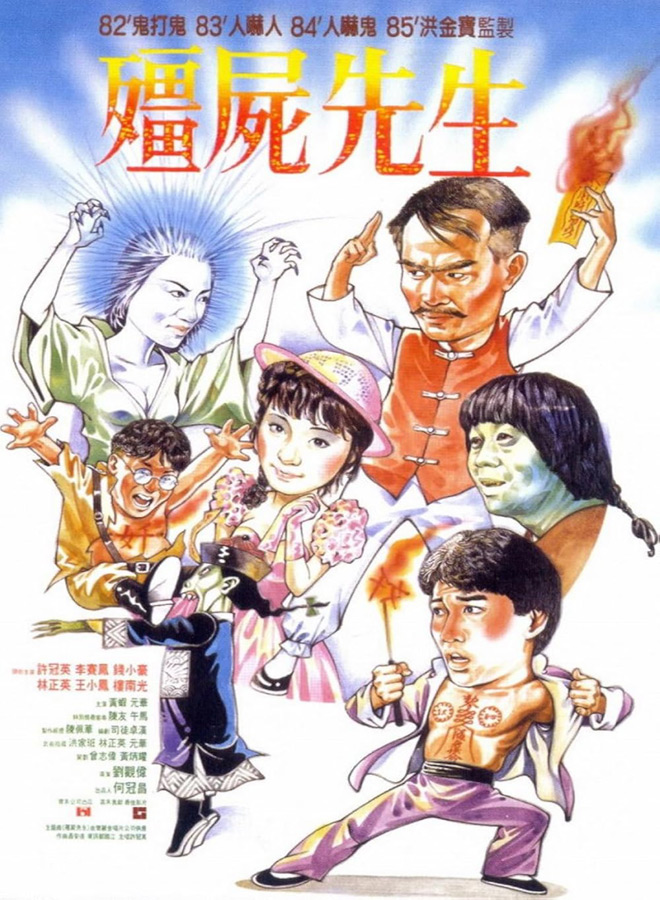
The Comedy-Horror flick Mr Vampire, produced by Bo Ho Films and Paragon Films, hit cinema screens in November 1995 via Golden Harvest and became a bigger success than anyone expected. Set during China’s Republican era in the 1910s, it follows Master Kau (Lam Chin-Ying), a Taoist priest, and his students, Chau-Sang (Chin Siu-Ho) and Man-Choi (Ricky Hui), as they help Mr Yam rebury his late father (Yuen Wah) to bring better prosperity. But during the exhumation, they discover that he has become a jiangshi- a Chinese hopping vampire.
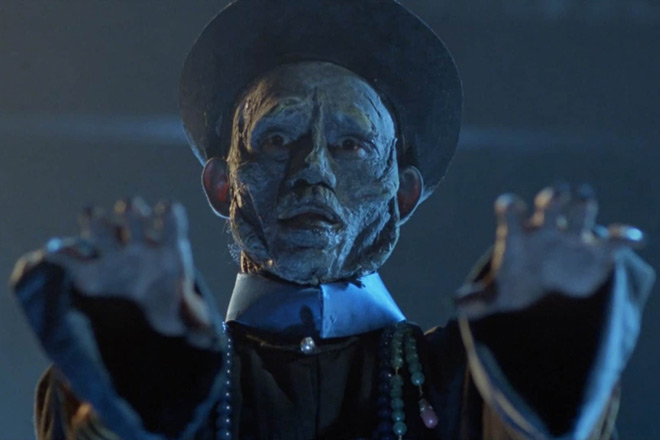
Their attempts to seal the jiangshi fail, and he begins to run amok, killing Mr Yam and any unfortunate souls it can catch at night in a bid to drain its life force. If that was not enough, Kau must deal with the ineptitude of police inspector Wai (Billy Lau), Man-Choi’s lack of luck, and a ghost that has taken a liking to Chau-sang. With backup like them, the town may be doomed.
The idea for the movie came from Hung himself, who was inspired by the spooky stories his mother told him as a kid and by the book Strange Stories from a Chinese Studio by Pu Songling. He even contributed to the script, offering ideas. Still, the final print was produced by Barry Wong, Ying Wong and Sze-to Cheuk-hon, with some bits from director Ricky Lau (The Romance of the Vampires 1994, Taoist Priest 2021), and the occasional ad-lib from the cast.
There were rumours that Hung had practically directed the film himself, as on top of having the original idea for the flick, Hung had done comedy horror before in movies like 1980’s Encounters of the Spooky Kind. In contrast, Lau was relatively new to directing at the time. But he was actually relatively hands-off, rarely appearing on set to avoid making the cast and crew feel tense about the ‘biggest big brother’ of the Three Brothers (Hung, Jackie Chan, and Yuen Biao) overlooking things. Direction-wise, the movie was all Lau’s work. Mr Vampire just happened to get a bigger reception than anyone expected.
As Frank Djeng reveals in the movie’s Blu-Ray commentary (released via Eureka Entertainment in 2020), the cast were not exactly the most prominent names around. Ricky Hui and his brothers, Michael and Sam, were a famous comedy trio in Hong Kong, though he was seen as the ‘Chico’ to their ‘Groucho’ and ‘Harpo,’ so to speak. Better than a Zeppo, but not as memorable as the others. Chin Siu-Ho got the role of Chau-sang through his good looks, on-screen charisma, and keen martial arts skills, yet he did not take off as well as his younger brother Chin Kar-lok, who made his fame as a stuntman and go-to hand for action scenes.
Nonetheless, they click well with each other on screen, with Hui’s hapless Man-Choi often acting as the butt of Chau-sang’s schemes and getting the brunt of Master Kau’s punishments. At the same time, Chin’s Chau-sang hits the balance between swagger and sympathy. In that, when his arrogant moments build up to some of the movie’s best laughs, particularly his crossed-signals conversation with Mr Yam’s daughter Ting-Ting. But his heart is in the right place, as shown when he is dealing with his would-be paranormal paramour, Jade.
Both, in turn, play off Master Kau, who would become Lam Chin-Ying’s breakout role. He is essentially the only one who knows what he is doing in the movie, yet he is caught short by his students, the authorities, and bad luck. Yet he manages to figure out a way around these issues with some jibes, a few hard smacks, and plenty of cunning, like when Chau-sang mistakes his request for sticky rice as a menu order rather than as a defence against the jiangshi. Plain sticky rice is to a jiangshi what holy water is to Dracula.
One would think many of the film’s techniques were based on classic folklore. But while some of Master Kau’s tools, like the bagua mirror and fulu talismans, come straight from the old stories, a lot of his techniques were made up by the writers. Due to the movie’s subsequent popularity, elements from it were carried over into other vampire movies made in its wake, so it can be hard to tell which come from the old stories and which from the multiple hands writing the script.
That said, for a Comedy Horror, many have said Mr. Vampire leans more into the former than the latter, which might explain its success. Despite the occasional gory corpse and monster make-up, much of the movie is spent mixing different kinds of yuks. Kau, Man-Choi and Chau-sang trade Cantonese puns with each other. Billy Lau’s Wai pratfalls against them, the vampires and a random gorilla. Ting-Ting even gets her own back at Man-Choi’s ogling with a gross-out gag, complete with a ‘womp-womp’-esque stinger.
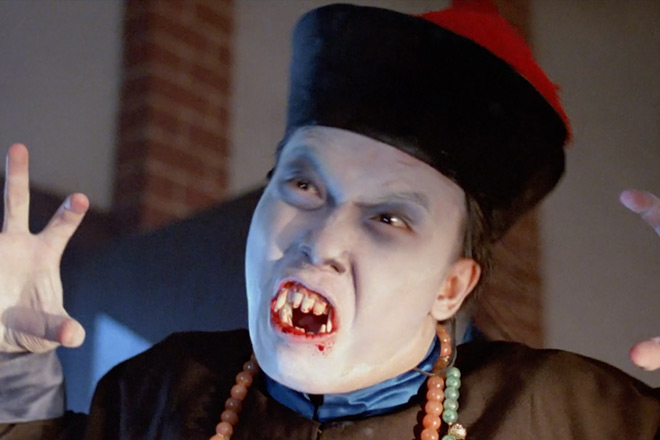
This, and the elaborate martial arts stunts, add to the movie’s charm, with some even comparing it (positively) to family films, as it is fun and accessible to viewers of all ages, but the very youngest. Given that jiangshi have the mindless shuffling terror of zombies, and the coffin-hiding, life-draining hunger of vampires, that might not do much for viewers expecting something bloodier or more terrifying. For hardcore horror fans, it might seem tame, beyond two brief scenes where someone cuts the liver of an actual (dead) snake out to make medicine, and one where a real (live) chicken is killed to produce the blood needed for the anti-jiangshi ink threads. According to Bey Logan on the DVD commentary, it was cheaper to do that than fake it.
On top of all that, it even has some romance! Well, of sorts. Chau-sang and Jade’s subplot plays a significant part, giving the movie its considerable musical number (‘Phantom Bride’) as Jade comes back to the land of the living, and seduces the guy into discreet tete-a-tete’s in the next town. There is a touch of Horror as she reveals her proper form to Master Kau for a quick but memorable fight. Though one could say it is there just to give viewers an extra, more complex antagonist, as the jiangshi can do little more than growl, fight and kill.
She does take a genuine liking for the guy, though her mentions of ensnaring him are problematic, mixing manipulation with literal hypnotism, while their prolonged contact slowly does him harm. Turns out there are drawbacks to “figures from different worlds” trying to bridge the gap. The way it pays off is effective, as she does ultimately do good in the end, though whether it is enough to make up for her misdeeds is another matter. It leaves the viewers siding with one lead or the other over as they ponder which verdict they should give Jade for loving a mortal.
Unfortunately, the conclusion to the main jiangshi plot is a bit shaky. It does have some neat callbacks, particularly its final punchline, and it has some of the movie’s best fight scenes. Yet it feels like it is rushing to wrap things up, as other plot threads get tied up ASAP without much clarification. However, that is a mild flaw compared to its two English dubs. The American one is the better of the two, as it sticks closer to the Cantonese script, despite the acting still sounding like a 1990s anime, complete with renamed characters (‘Dan’ instead of Man-Choi, ‘Tina’ instead of Ting-Ting) and altered sound effects. Europe’s dub had a cast of cod-American accents exchanging gags that would not have made it into 2002’s Kung-Pow! Enter the Fist (“Your dear departed relative will feel the sun again. He will be pissed”).
Nonetheless, on Mr. Vampire’s original release, it became a hit across China, Taiwan, and Japan, and sparked two distinct horror crazes. First, it led to a wave of jiangshi-themed flicks being made across the continent, with some even being titled as sequels, like 1986’s Mr Vampire 2 (aka Vampire Family) and 1987’s Mr Vampire 3, despite not being canonical follow-ups to the first movie. They just happened to have jiangshi, and Lam Chin-Ying in a role that referenced his alter ego in one way or another, as the yellow robes and monobrow became to him what Van Helsing became to Peter Cushing.
It did get a proper sequel with Mr. Vampire 1992, which was a step-up from some of the pseudo-sequels, though still a step down compared to the relatively well-received Mr. Vampire 2 and 1989’s Vampire vs Vampire, where Lam Chin-Ying’s similar-but-different monobrow priest and his similar-but-different understudy (also played by Chin Siu-Ho) have to figure out how to take out a European vampire who got lost somewhere between China and Transylvania.
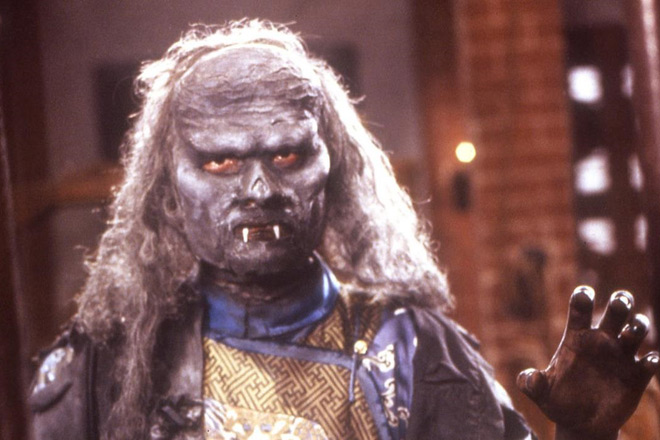
Outside of movies, it received an NES video game, released in the West as ‘Phantom Fighter’, a TV series called Vampire Expert that Lam starred in before his premature passing in 1997, a 2010 stage play, and various attempts to make a Western remake. Golden Harvest did start shooting one, titled ‘Demon Hunters,’ which was filmed with Michelle Phillips (of The Mamas and the Papas) in a role, but they cancelled the project partway through and sealed its footage away in their archives.
The second craze it kicked off was a taste for ghostly romances. Well, possibly. Djeng gives the nod to Mr. Vampire in his commentary, but the movie was preceded by 1983’s Esprit d’amour, where an investigator falls in love with the ghost of a murdered woman. Even then, some stories go back centuries about the mingling of the natural and the supernatural. Even so, both would inspire the 1987 Chow Yun-Fat ghostly romcom Spiritual Love, in that the English title references Esprit, while the Cantonese one is the same, hanzi for hanzi, as Mr. Vampire’s ‘Phantom Bride’ tune (鬼新娘).
Nonetheless, that is quite the legacy for a humble film that was expected to do just as humbly at the box office: a Comedy-Horror where the ‘Horror’ is lowercase and the Comedy is capitalized and put in italics. But it was written so well, directed effectively, and performed with enough charm that it became a cult classic. For anyone who’s only seen the works of Bruce Lee or Ang Lee, or is tired of Chan, Woo or Kar-Wai, they should take a hop off the beaten track and check out Mr. Vampire.


No comment