

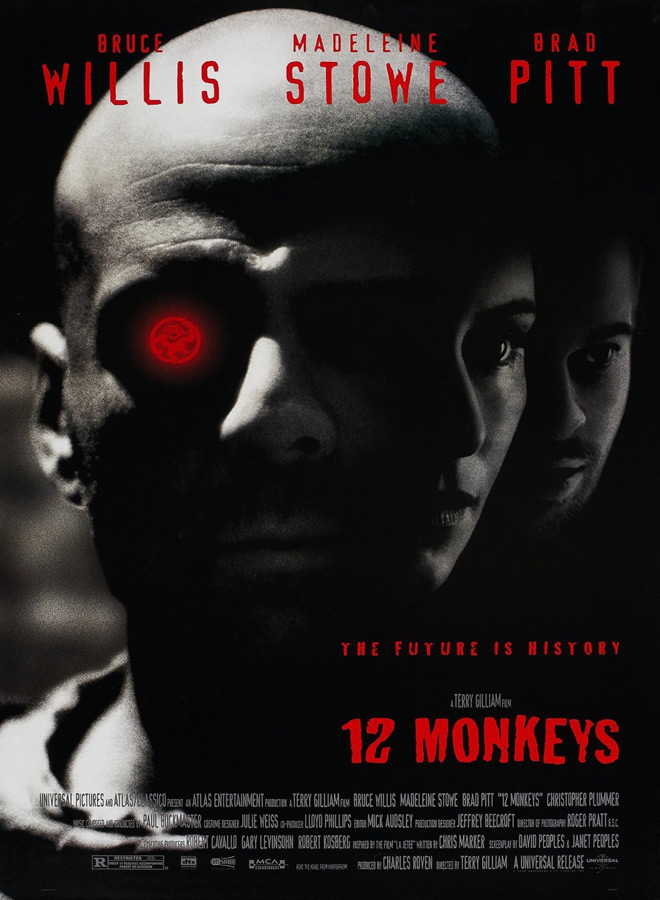
Three decades after its release, 12 Monkeys still feels like a warning shot from the future. Terry Gilliam’s mind-bending 1995 Sci-Fi Thriller did not just imagine a world undone by a virus; it challenged how we think about time, memory, and the fragile line between madness and truth. Anchored by Bruce Willis’ emotional performance and a career-defining turn from Brad Pitt, the film remains as unsettling, prophetic, and emotionally gripping today as it was when audiences first stepped into its fractured timeline. On this anniversary, 12 Monkeys stands not merely as a cult classic but as one of the most enduring and eerily relevant Science Fiction films of its era.
Initially released in limited theaters in the United States on December 29, 1995, through Universal Pictures, Terry Gilliam brings to 12 Monkeys the same unruly imagination that defined his work with Monty Python and films like 1985’s Brazil, filtering a studio Sci-Fi Thriller through his trademark lens of bureaucratic absurdity and visual excess. His future is not sleek or heroic but grimy, claustrophobic, and ruled by faceless systems that treat human lives as expendable data points. This perspective still feels relevant today, as many directors in the genre continue to explore dystopian futures shaped by dehumanizing systems. It is also an especially compelling watch in a post-COVID world, where the film’s virus-driven fears no longer feel abstract, but uncomfortably familiar. All of it adds up to 12 Monkeys as an unmistakably Gilliam film, shaped less by genre expectations than by a director obsessed with the cruelty of systems, the fragility of sanity, and the tragic absurdity of trying to change a world that refuses to bend.

12 Monkeys has had a quieter but lasting influence on modern Sci-Fi, especially in how films approach time travel, dystopian futures, and unreliable perspectives. One of its most significant legacies is the idea of time travel as tragic and deterministic, not empowering. Instead of heroes changing history, Gilliam presents a closed loop where fate cannot be escaped. You can see echoes of this in films like 2012’s Looper, 2014’s Predestination, and 2016’s Arrival, which treat time as emotionally crushing and morally complex rather than a puzzle to “solve.”
The film also helped popularize the gritty, analog dystopia, futures that feel dirty, bureaucratic, and patched together rather than sleek and digital. That aesthetic shows up in everything from 2006’s Children of Men to 2013’s Snowpiercer, and even in The Matrix’s real world, where humanity survives in decaying systems rather than shining Sci-Fi cities.
Another key influence is its use of the unreliable protagonist. By keeping us trapped in James Cole’s fractured perspective, the film blurs the line between prophecy and psychosis. That approach has become a staple in modern Sci-Fi and Thrillers, seen in movies like 2010’s Shutter Island, 2011’s Source Code, 2014’s Ex Machina, and 2018’s Annihilation, where audience doubt is central to the experience. This narrative choice would not work without an actor capable of conveying both confusion and urgency, which is where Bruce Willis’ performance as James Cole becomes central. With that in mind, Bruce Willis’ performance as James Cole is really the emotional spine of 12 Monkeys, and it is one of the most interesting turns of his career because it deliberately subverts his action-hero image.
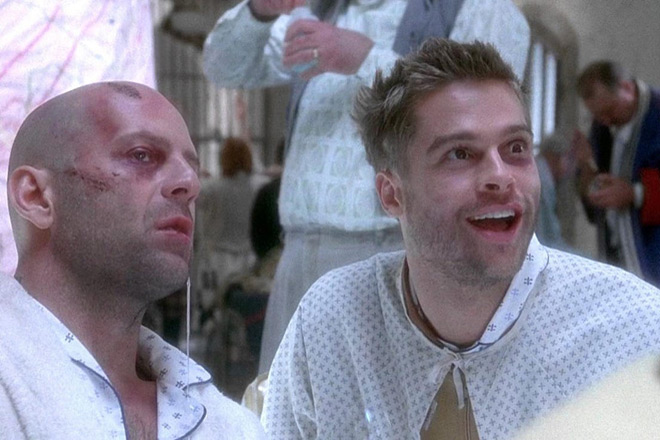
Coming off roles that cemented him as a confident, wisecracking lead, Willis plays Cole as fragile, confused, and deeply human. From his first scenes in the underground future, he is hunched, soft-spoken, almost childlike, a man stripped of agency and certainty. When he is thrown back into the past, Willis leans hard into disorientation: darting eyes, halting speech, sudden bursts of panic. You feel that Cole is never in control of his own story, which mirrors the film’s obsession with fate.
What stands out is how much Willis communicates through physicality rather than bravado. He looks perpetually out of place, whether in an asylum, on city streets, or trying to pass as “normal.” There is a constant sense that Cole is carrying a memory he cannot quite touch, which makes his eventual recognition of his own destiny all the more quietly devastating.
This is while Brad Pitt delivers a career-defining performance as the unhinged Jeffrey Goines, stealing scenes with a manic energy that teeters between chaos and dark comedy. His Goines is unpredictable, mercurial, and utterly captivating, a character whose volatility makes him both frightening and magnetic. Many critics and fans see this role as a direct precursor to Pitt’s later work in 1999’s Fight Club, where he channels a similarly anarchic, magnetic energy as Tyler Durden. In both films, Pitt embodies a charismatic force of disruption, drawing the audience into the mindset of someone who lives on the edge of societal norms while leaving a lasting impression that transcends the narrative. This combination of memorable performances and Gilliam’s distinctive vision helped draw audiences to theaters, contributing to the film’s commercial success.

Overall, 12 Monkeys was a solid commercial success, especially for a cerebral, mid-budget Sci-Fi Thriller. Produced on a budget of around $29 million, the film went on to gross approximately $169 million worldwide, earning nearly six times its production cost. It also topped the U.S. box office for two weeks after its wider release in January 1996, proving that audiences were drawn to its mind-bending story and darkly dystopian vision. While not a success on the scale of a summer blockbuster, its strong financial performance cemented the film’s status as both a critical and commercial hit.
Thirty years later, 12 Monkeys never lets you settle. Its fractured story, morally ambiguous characters, and darkly prophetic vision keep tugging at the edges of your mind, long after the screen goes black. It is a film that reminds us how fragile our sense of control really is, and that the chaos Gilliam imagined in 1995 is, disturbingly, still all around us.



No comment