
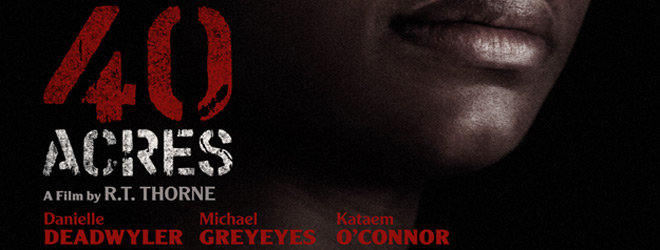
Coming to select theaters on July 2, 2025, through Magnolia Pictures, 40 Acres marks the bold and uncompromising feature debut of Canadian Filmmaker R.T. Thorne—best known for the genre-blending 2020 series Utopia Falls and the award-winning 2022 Historical Drama The Porter.
Developed over the course of seven years, 40 Acres draws on Thorne’s personal anxieties during the COVID-19 pandemic: food insecurity, systemic neglect, and the primal instinct to protect one’s children. Set in a chillingly plausible near future, 40 Acres follows a Black farming family—descendants of American Civil War migrants—who must defend their land and legacy from a savage new threat: roving cannibals hungry for more than just food. Visceral, politically charged, and emotionally grounded, 40 Acres plants its feet firmly in the soil of dystopian cinema while digging deep into generational trauma and survival.

Anchored by a fierce and emotionally layered performance from Danielle Deadwyler (Till 2022, The Piano Lesson 2024), 40 Acres finds its heart in the role of Hailey, a mother whose strength is both her armor and her vulnerability. Deadwyler brings quiet intensity and raw maternal instinct to every scene, capturing the weight of survival in a collapsing world.
Opposite her, Kataem O’Connor (Fitting In 2023, Timecut 2024) shines as Emanuel, Hailey’s teenage son, whose simmering frustration and youthful defiance evolve into a deeper understanding of sacrifice and legacy. Together, their dynamic is electric and deeply human, rooting the film’s dystopian horrors in something achingly real: the unbreakable bond between parent and child.
The cannibals in 40 Acres rank among the most genuinely terrifying villains in recent dystopian cinema, not simply for their actions, but for what they symbolize. They are far from cartoonish monsters or gore-fueled shock tactics; instead, they are desperate, calculating, and hauntingly human. Thorne masterfully sustains a palpable tension, reflecting the characters’ constant uncertainty about whom to trust in this fractured world.

At the emotional center is Emanuel, portrayed with striking authenticity as a teenage boy caught between innocence and harsh reality. His nuanced blend of curiosity and cautious hope—a yearning to find glimmers of humanity amid relentless danger—creates a powerful emotional counterpoint to the pervasive fear around him. Emanuel’s tentative openness sharply contrasts with the suspicion and protective anxiety instilled by his mother, adding rich layers of emotional complexity. This fragile balance between hope and mistrust amplifies the film’s tension, transforming every encounter into a precarious dance between connection and devastating betrayal.
Thorne’s portrayal of Emanuel captures the essence of modern youth—vulnerable yet resilient, curious yet wary. Despite the dystopian backdrop, Emanuel feels deeply familiar and relatable, embodying the universal struggles of adolescence intensified by extraordinary circumstances. His grounded, multidimensional characterization bridges the gap between the familiar and the speculative, inviting audiences to connect on a profoundly human level. Through Emanuel’s journey, 40 Acres reminds us that even in the bleakest, most unforgiving environments, the hopes, fears, and desires of youth remain powerfully recognizable and deeply moving.

While 40 Acres excels in character development, its narrative structure occasionally feels better suited to a television format than a feature film. The chapter-based storytelling, though ambitious, sometimes disrupts the film’s overall flow, causing the momentum to waver at key moments. Additionally, the frequent use of flashbacks—while effective in enriching the characters’ backstories—can at times feel more like episodic storytelling than a cohesive cinematic experience, resulting in some uneven pacing.
40 Acres is not just another Dystopian Thriller—it is a gripping, emotionally charged story about family, hope, and the strength it takes to hold on to your humanity when everything else is slipping away. Thorne utilizes the harsh, unforgiving setting not just for tension, but also as a backdrop for exploring the profound emotional bonds between a mother and son, and the distinct ways they confront fear, loss, and uncertainty.
It is rare for a Horror film to invest this deeply in character development, and that is what sets 40 Acres apart. It is thoughtful, intense, and at times, uncomfortably real, which is why Cryptic Rock gives 40 Acres 3.5 out of 5 stars.



)
No comment