

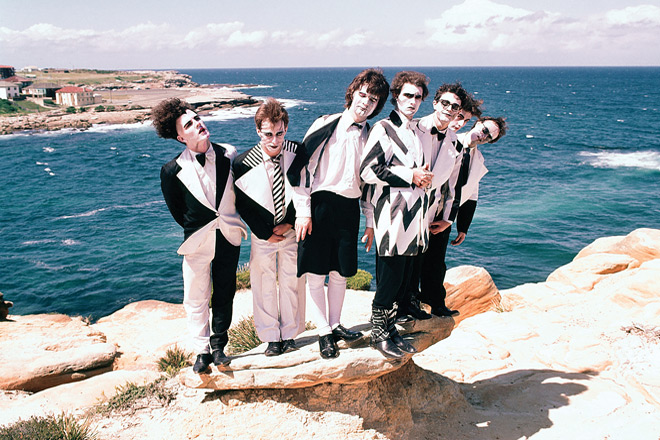
To an outsider, New Zealand is a place of stunning natural landscapes and the filming location of The Lord of the Rings trilogy, but it is seldom known for its Rock-n-Roll scene. It is not to say the region does not produce talented bands, but historically, few have made the international impact as Split Enz did some fifty years ago.
A highly unique band which came together in the early 1970s, Split Enz would go on to top charts in New Zealand with each of their nine studio albums, while also attaining massive acclaim in places like the United States with their 1980 album True Colours. A story of very different musical adventures spanning a decade, Split Enz’s sound ranged from Progressive Rock to a more New Wave vibe, leading into the 1980s.
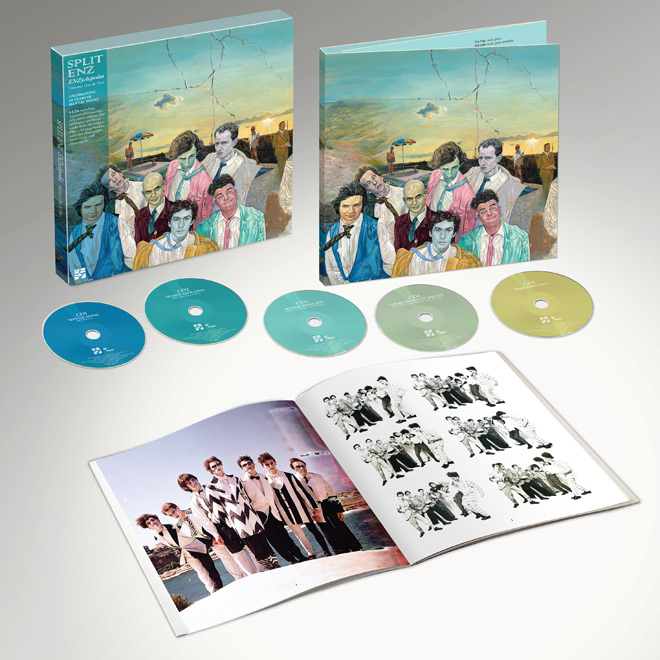
Famously known around the globe for hits such as 1980’s “I Got You,” Split Enz history is one that runs far and deep, as explored in their newly released 2025 box set ENZyclopedia Volume 1 & 2. A collection that looks at the band’s early years (1975’s Mental Notes and 1976’s Second Thoughts). Accompanied by a reunion tour of New Zealand and Australia in 2026, could this be the start of something more Split Enz? An exciting time for long-time fans, Split Enz’s keyboardist, Eddie Rayner, took time to chat about their early years, the new box set, getting back together, plus much more.
Cryptic Rock – Split Enz has a very long and fascinating history. The band is considered one of the most successful ever to come out of New Zealand. How would you describe the journey of Split Enz?
Eddie Rayner – It was one that could probably have only been done coming from New Zealand. We often talk about how, if we’d started in America or Europe, our rise to some significance might have been a bit quicker and easier.
Coming from New Zealand, where, back in the day, when we first started in 1973 and 1974, it was very difficult to play original music without being booed off stage or heckled. People wanted to hear the hits. In the end, we decided to leave New Zealand. We didn’t have any bad feelings about New Zealand. That’s just the way it was.
We went to Australia first. Australia was a breeding ground. It was a fantastic circuit over there. You could play on this circuit of gigs, which was quite extensive. You could play up and down the east coast of Australia. We did that for a whole year. We played maybe four or five times a week for a year. That’s where we cut our teeth as a band. We became a really good band in Australia.
When Phil Manzanera from Roxy Music saw us playing, we were supporting them, and he poked his head into the dressing room and gave us a great compliment about our performance. He said if we want to do any recording, he’d love to produce us. That’s what took us off to the rest of the world. If it hadn’t been for the Australian leg of our career, it would have been a much different story for the band.
Cryptic Rock – It is fascinating to hear how all that happened. Up to that point, you were a hardworking band. You were doing a lot of live shows. You were pretty strong and tight as a band even before recording an album.
Eddie Rayner – Pretty much. Although having said that, the moment we hit the shores of Australia, it was a fairly traumatic entry with our first couple of shows. We were billed as New Zealand’s raunchiest Rock band when we arrived in Australia, which is not what we were at all. We were more closely aligned with a Folk band. We were electric, but we certainly weren’t a raunchy Rock band. It was a bit difficult for the first few gigs.
In short order, Michael Gudinski from Mushroom Records came to one of our gigs, liked the band, and signed us up. We were recording, maybe three or four months after we arrived in Australia. We hadn’t really done the bulk of the work that we needed to do to become a great band.
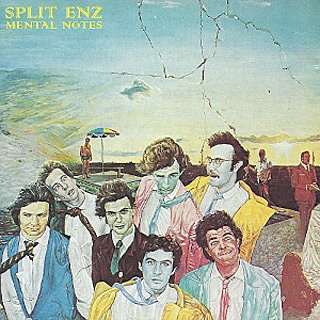
That’s probably why, in my opinion, we decided to re-record the first album with Phil Manzanera. We recorded Mental Notes in June ’75. I remember not being that satisfied with it myself. I just thought that the record didn’t match the real sound, dynamics, or power of the band. We decided that we would go to England and re-record it with Phil.
Cryptic Rock – Right. The version produced by Phil Manzanera is the one most people recognize.
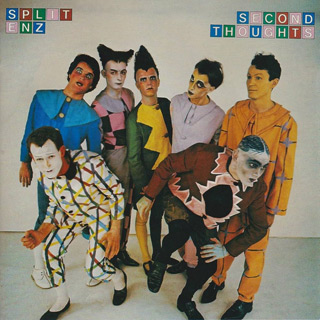
Eddie Rayner – Yeah. Most people around internationally know the recorded version with Phil Manzanira, which is slightly different. It might actually be five songs different than the original version we recorded back in ’75 in Australia, which was not a lot of overdubs. It was pretty much as we played it live. It was recorded like that, and there were vocal overdubs and a bit of this and a bit of that, a little bit of experimentation later on. Mostly, it was as we played it live.
Cryptic Rock – It has always been said, “You only have one time to make your first album.” You kind of had two times to make your first album in a way.
Eddie Rayner – Yeah. We did. When we swapped out a few songs while we were in England recording with Phil, it turned into a different album. It was intended to be the same album, but it turned out to be a different one. The title, Second Thought, seemed really appropriate for it.
Cryptic Rock – Mental Notes celebrates its 50th anniversary in 2025, which is hard to believe. With that said, you have this new set out entitled ENZyclopedia Volumes One & Two, and the band has reunited for shows in 2026. There are some interesting developments with Split Enz.
Eddie Rayner – Yeah. It was pretty odd. Neil Finn has been sort of pushing for us to play a show or a series of shows showcasing the original album, the early material. We were just on a Zoom one day, all talking together with our manager, and just shooting the breeze. Next minute, we’re talking about playing shows. It seemed like in that one telephone call, which was only a few months ago, that somehow the band reformed. I was a bit of a stunned mullet at the end of the call because it’s not what I expected at all. I didn’t even know whether I wanted to do it. The more you think about it, the more it becomes an exciting prospect for the future.
Cryptic Rock – It is all very exciting because this is the first time that this lineup has played together in 17 years for a reunion show.
Eddie Rayner – Yeah, 2008 was our last show. It just seems like yesterday. It certainly doesn’t feel like 17 years to me. It might look like 17 years on my face.
Cryptic Rock – (Laughs) Time definitely goes by very quickly. So, ENZyclopedia Volumes One & Two is very cool because it gives a good look into the band’s beginnings, as you mentioned just before. It includes remixes and unreleased material. With five discs, there is a lot dive into.
Eddie Rayner – Yes. There’s going to be four or five separate box sets. When they’re all released and combined, they will become the ENZyclopedia set.
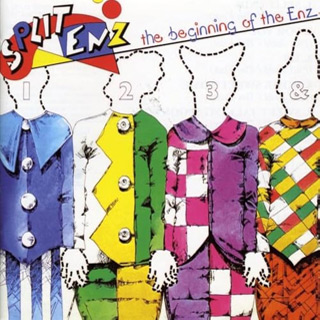
This first set is Beginning of the Enz, which was all the early material, before the first album, collated onto one album. There’s Mental Notes, the original copy. Then there’s Second Thoughts, the one with Phil Manzanera from 1977. Then there’s the Atmos album. There’s a bonus album of material, too.
There wasn’t as much bonus material as we would have liked for this first box set because we were just starting back then. There was no such thing as mobile multi-track recording at that point. Proper recording sessions were few and far between. Most of the stuff that we’ve got from that time would be on cassette, which is seriously compromised audio-wise. We decided that we would forgo anything that wasn’t up to scratch sound-wise. There’s a little bit of bonus material, but mostly it’s just the interesting pre-Mental Notes stuff, and remixes. I did the remix of Second Thoughts as well.
Cryptic Rock – It is all exciting to listen to. The original Second Thoughts done by Phil is fantastic. Your remix sounds a little bit different. So, what inspired the remixes?
Eddie Rayner – That’s a good question. I tend to remix anything Enz that I can get my hands on. I’ve been remixing live stuff. I used to be the prime mover when it came to recording as much as we could record, particularly live. There are a lot of live mixes that I’ve done. I’ve probably got 120 live mixes on my hard drive somewhere, which will be coming out over the course of the subsequent packages that are coming out with Chrysalis.
It’s ironic because Chrysalis were the people who signed us originally back in 1976 in England. I think they’re called Blue Raincoat now. They have resigned us for these releases and for a couple of other things as well, I believe. They sent me everything they had. They digitized all of their multi-tracks that they could find and sent them to me. I had a lot of stuff to play with.
I had no intention, from the get-go, of remixing Second Thoughts because I liked the mix the way it was. I guess curiosity gets the better of you. You start playing with it. The next minute, you’ve got a mix which sounds a bit different, and you send it to the record company, and they go, “Wow, that sounds really good.” I finished it. If it hadn’t been for the record company, it could still be sitting on my hard drive. I wouldn’t mind that either if it hadn’t been released, but I think it sounds good. It’s a worthy different alternative version.
Cryptic Rock – Most certainly. It sounds terrific. It is interesting to listen to them back-to-back as well, because you can hear the nuances and differences.
Eddie Rayner – Oh, okay. I haven’t done that yet. Back in the day, as well, one of the things that stuck in my core a bit about all of our recordings was that Noel Crombie was never given a fair suck of a salve, as they say in Australia, on the recordings. He was often underrepresented on the recordings. I thought I’d really go out of my way to try and represent his parts and represent him better on these new mixes. All of his stuff was recorded on its own tracks and things, but somehow it just was mixed down on every recording we ever did, I feel.
Cryptic Rock – That is an interesting point. Sometimes, mixes reflect the time they were made. We hear ’80s drums, they sound different than drums nowadays. Maybe they were mixed that way for that reason?
Eddie Rayner – Yeah. Maybe percussion wasn’t such a thing then, unless you were a Santana band or virtuosic conga player or something. I don’t know. To get a little bit technical, he used to have a whole array of percussion instruments that he would set up. Then they would be miked, not individually, because there were so many bits and pieces, so many toys he was playing with, but there would be a mic just over the top of everything.
A lot of the sounds would go down on a stereo percussion track. It must have been a nightmare to mix with some of the sounds being a lot louder than others. Maybe it was just one of the things that engineers did to bring it back a bit so that the loud bits, you can hear those, but you couldn’t hear the subtleties that are playing.
Cryptic Rock – It sounds rich and dynamic. Looking at the songs from Split Enz’s first two records, these are really unique arrangements. They seem to fit very well together, but they are also very experimental in many ways. What was it like creating these songs back then?
Eddie Rayner – I think it was probably different for everybody in the band. We all had our own aspirations and our own likes and dislikes. It was pretty much a grab bag of a whole bunch of different styles, influences, and ideas being thrown together. We made them work somehow.
There was a spirit of everybody wanting everybody else to contribute their own ideas, to write riffs, make up sounds, and add a bridge or an outro. There was a great spirit in the band. That pretty much was all the way through. There was a willingness, mainly from the writers, to actually incorporate everybody’s musical wishes in terms of styles and sounds, or at least to experiment and give ideas a fair shot.
Cryptic Rock – That experimentation is what makes it exciting and interesting, the different inputs.
Eddie Rayner – Yeah. I think so. It certainly makes it different. I don’t think many people do that these days, particularly with the way writing is done these days; so much formula going on. We didn’t have a formula. We just did whatever.
In fact, we actively shunned formula in all ways. The way we looked, the way we played, we just felt like we were outside the music industry and the way people dressed, the way they looked, the way they sounded, the music they played and that sort of thing. We wanted to be as different and as unusual as we could. We felt that was where our strength was.
Cryptic Rock – As you said, that is what makes it fun and exciting. You mentioned that there will be other box sets. Are they going to go along the trajectory of the band through the years, going into the later part of the ’70s, ’80s, etc?
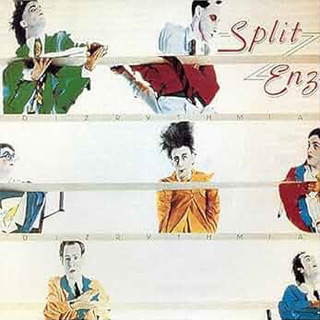
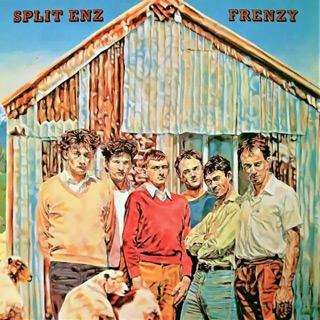
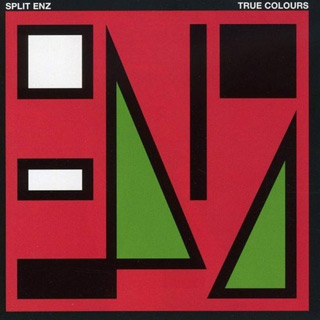
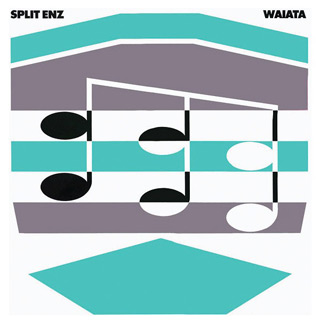
Eddie Rayner – Yeah. The next one will be Dizrythmia (1977) and Frenzy (1979). I’ve remixed both of those. There’ll be a lot of extra material, a lot of bonus material that people haven’t heard before. That’ll be followed by True Colours (1980), which was called Waiata (1981) in America. They seem like sisters, the albums that are coming out. Frenzy and Dysrhythmia, that was a time when Tim took over as main songwriter with me as his sidekick. There were two albums. They seemed to belong together like a pair. The same with True Colours. That was when Neil emerged as a very strong writer, with True Colours and Waiata. True Colours is when we were really at our peak.
Cryptic Rock – It should be interesting to hear the other material coming out after these. It is also compelling because you can see the changes, progressions, and different styles you used and worked with over time. As you mentioned, True Colours was a massive album for Split Enz with a lot of success.
Eddie Rayner – Yep. Absolutely. That was probably due in no small part to the producer, who was David Tickle, who’d been doing a lot of work as the engineer for Graham Chapman. He did bands like Blondie. He’d learned production techniques from Chapman. Apart from the fact that the band had been playing so much, we felt like we were on the crest of a wave at that point.
We’d built up so much goodwill. We’d built up such a great repertoire, and we were becoming a great band at that point. It felt like all the planets were lining up. When David came in as producer, he just seemed to be the right producer for us. He managed to extract that type of album from us, which was kind of Poppy. I’m not sure whether we wanted it to go that way, but that’s how it ended up. He was a perfect producer for that album.
Cryptic Rock – It definitely was a little different, like you said, a little more Poppy, but it worked out really well.
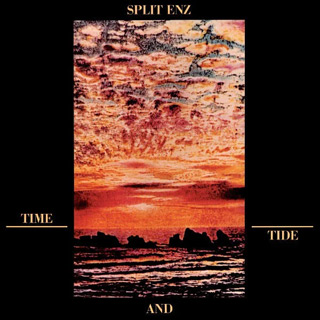
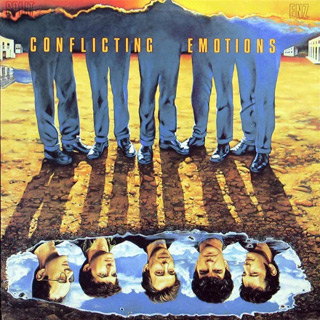
Eddie Rayner – I guess there was the Phil Judd era, the early Split Enz stuff, which a lot of people love. Then, Tim took over, and there were a couple of albums on which he was the main songwriter. Then Neil came along for a couple of albums as the emerging new songwriter, he and Tim together. After that, you’ve got the Time and Tide and the Conflicting Emotions album, which also features both of them heavily. It feels like a bit of a strata of timeline. That’s why we have these boxed sets coming out.
Cryptic Rock – Looking back at these different eras is fantastic because they are so different, and these box sets will help shine light on that. The band has had reunion shows over the decades since its initial dissolution in 1984. Putting out a lot of material over a decade, it was a good time to move on to other things. Crowded House came along, and Tim Finn was doing his thing solo. At the time, looking back, what was the reason Split Enz decided it was time to move on for a while?
Eddie Rayner – It was different for everybody. Tim went off while he was still in Split Enz and made a solo album. We were quite happy with him doing that. His album Escapade (1983) was a success, giving him a taste of what it was like to be a solo artist. It had been a long time. He started the band with Phil Judd in 1973, and he left in ’84. That’s 11 years, and it probably just felt like time, but I can’t really talk for him.
For myself, I felt like I’d had enough, at least wanted an extended holiday from touring because we really never had a home in those 12 years that we were a band. There was just so much travel done. There were certain things that I wanted to do. I wanted to do some production, more mixing. I love mixing. It’s my happy place when I’m in the studio. It felt like time for me as well.
Whether we really needed to make the big breakup announcement was another thing. In hindsight, maybe we shouldn’t have. We’re all friends. We’ve all been friends ever since. There was no acrimony at all. When we broke up, it just felt like a natural progression to move on, do something different.
Cryptic Rock – Understood. Eleven years is a long time, like you said, and touring can be very exhausting.
Eddie Rayner – Yeah. Really exhausting, and it can screw you up mentally as well. We all went through funny periods of anxiety and panic attacks before panic attacks became a thing. We were having them back in the 80s. Not everybody in the band was, but I had a very bad period. Tim did as well. Nigel did as well. It was just weird. Was it a signal? Who knows? Have a rest. Settle down. Get yourself a home. Get yourself a base. Get some proper friends around you. Go back to the family.
Cryptic Rock – Right. You need some time to unwind. You mentioned that you have all remained friends. You have collaborated with Tim in the past on other projects as well. With Split Enz doing these reunion shows and these box sets, has there been any discussion of maybe writing a couple of new songs together?
Eddie Rayner – I’ve been quite bald-faced about it. I’ve said I want to make another album. There’s just been this silence, and you hear a few heads being scratched. But you never know.
With this band, as I said earlier, we were talking on a Zoom call, and the next minute, it felt as if the band was reforming, maybe not forever, but for a while to do some gigs, which was quite a shock. With recording, I’d love to do another album or another body of work. Go to the studio for a couple of months and see what we can do as a band. Yeah, it’s been a long time between drinks, really.
Cryptic Rock – It would be interesting to hear for sure.
Eddie Rayner – I wouldn’t discount it.
Cryptic Rock – Well, you never know what is going to happen, as you said.
Eddie Rayner – Yeah, you don’t. Not with that. We always said we stumble along from disaster to disaster (laughs). Not so much disasters, but it was just the band’s modus operandi, just stumbling along from one scenario to another.
Cryptic Rock – Well, that’s just the way life is sometimes, right?
Eddie Rayner – Absolutely. Yeah
Cryptic Rock – We discussed the history of Split Enz, the new box set, the reunion shows, etc. You have been involved in music for a very long time, and you have done a lot of things outside Split Enz as well. What do you take away from all the experiences that you have had as a musician?
Eddie Rayner – I think music is a hell of a career. It’s an incredibly rewarding thing to do. It’s fantastic. Music is such a mystery. That’s the thing that keeps me calling myself a musician. How can you start with nothing, not even any ideas, and within a short period of time, have completed a beautiful piece of work? Where does it come from? How does it come through you? I believe it comes through me, and it doesn’t come from me.
It’s a very difficult career. It’s very difficult to pay your bills in the music industry. It’s an art, isn’t it? Art is not a service. I’m not a plumber. You’re dealing with the vagaries of fashion, really, with art. You can be an incredibly fashionable musician and be no good, and you can be incredibly unfashionable and be a genius. Who knows the whys and the wherefors of that? It’s all I know. It’s the only real job I’ve ever had. It’s not a real job at all, but it’s really the only thing I’ve ever done. I love doing it, and I wouldn’t have it any other way. Albeit, it is difficult to make a decent living from it.
Cryptic Rock – Understandable. The reward is in the process. Any artist would agree with that. The creation is the reward, and that is what keeps you inspired, keeps you going, and wanting to do it.
Eddie Rayner – Yeah, that’s right. You work out ways of cobbling a living from it. There’s a strand here, a strand there, a bit of MDing here and a bit of session work there, a few gigs here and there. It all works out.


No comment