
When 1997’s Batman and Robin bombed at the box office, people thought the Caped Crusader would never return to the silver screen. It took 1987’s Superman 4: The Quest for Peace to end the Man of Steel’s cinematic prospects for nearly 20 years, and, at the time, Spider-Man’s journey to theaters was tied up in a web of legal red tape. So, it did not look like Batman would bounce back anytime soon. Not that this stopped other filmmakers from trying.
If Batman and Robin had succeeded, Joel Schumacher (8MM 1999, The Phantom of the Opera 2004) would have continued the storyline with Batman: Unchained, where Batman would have taken on the Scarecrow, likely to have been played by Nicholas Cage (Con Air 1997, Renfield 2023), Harley Quinn, and fear toxin-induced hallucinations of his past villains, including a return for Jack Nicholson (Five Easy Pieces 1970, The Bucket List 2007) as the Joker from 1989’s Batman. Whereas Darren Aronofsky (Pi 1998, Requiem for a Dream 2000) would have adapted the Batman: Year One comic with some adjustments.

Rejigged by Batman: Year One’s original writer, Frank Miller (Robocop 2, 1990, Sin City, 2005), it would have seen a penniless Bruce Wayne get mentored by a black mechanic called Little Al. He would operate out of an abandoned subway station as his Batcave and drive a Lincoln Continental as his Batmobile. Though he half-joked that he would set it in Tokyo and cast Clint Eastwood (Unforgiven 1992, Space Cowboys 2000) in the title role, the actors he had in mind were future Joker Joaquin Phoenix (Gladiator 2000, Napoleon 2023) and Christian Bale (Empire of the Sun 1987, American Psycho 2000).
There were other prospective Bat-projects during that time. Grant Morrison intrigued past Bat-men Val Kilmer (The Doors 1991, Kiss Kiss Bang Bang 2005) and George Clooney (Good Night and Good Luck 2005, Hail, Caesar! 2016) with a film noir-style story that would have seen Alfred and Robin get killed in action. Rumors of a live-action Batman Beyond movie were rife as the series was flying high. The long, torturous journey of Batman vs. Superman from concept to cinema also involved several drafts.
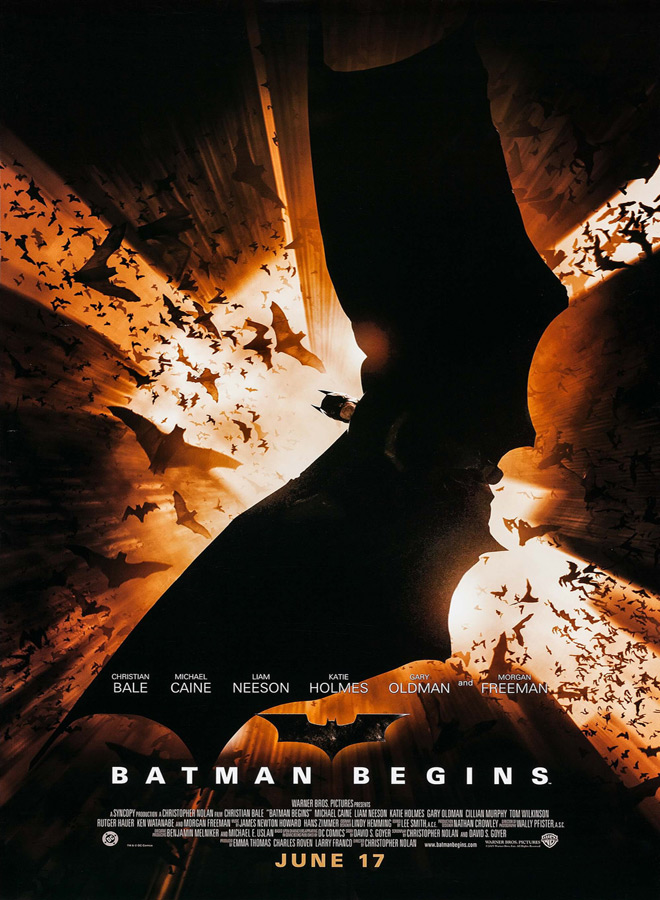
But by early 2003, Variety magazine revealed Warner Bros would bring Christopher Nolan (Inception 2010, Oppenheimer 2023) in to make a new Batman film, who would write the script with David S. Goyer (Dark City 1998, Terminator: Dark Fate 2019). At the time, Nolan was best known for the 2000 reverse-order, memory-twisting mystery Memento, and Goyer for writing the R-rated bloody violence of 1998’s Blade. Hence, Bat-fans knew it would be as far from Batman and Robin’s neon-glow campiness as possible.
The plan was to tell Batman’s origin story in a more grounded way, showing how Bruce Wayne grows from a traumatized child into his alter ego. All within a Gotham City that looks more like Chicago (by design and by location) than the gothic dreams of Tim Burton or the art deco look of the animated series. Yet it would take cues from the comics. Wayne’s fall in the well (also seen in 1995’s Batman Forever), his martial arts training, and the character of Henri Ducard came from the short story The Man Who Falls.
Carmine Falcone (Tom Wilkinson: The Full Monty 1997, Eternal Sunshine of the Spotless Mind 2004) and his mobsters’ role in the plot was inspired by ‘The Long Halloween’. While everything else, like Wayne’s globetrotting sojourn away from Gotham, the arc of Sergeant Jim Gordon (Gary Oldman: Sid and Nancy 1986, The Fifth Element 1997), and select action scenes (notably the bat-attracting sonar) came from Batman: Year One, ironically making it more faithful to the comic than Aronofsky’s project would have been.
Others got changed for the sake of the plot. To reinforce the bat-complex Wayne developed from his well fall, the Zorro movie he and his parents saw before their fateful trip into Crime Alley was replaced with an opera featuring bat-like figures. While future Two-Face Harvey Dent was replaced with childhood friend and love interest Rachel Dawes (Katie Holmes: Dawson’s Creek series, Thank You for Smoking 2005) because Nolan and Goyer felt they “couldn’t do him justice.” Not for a few years anyway.
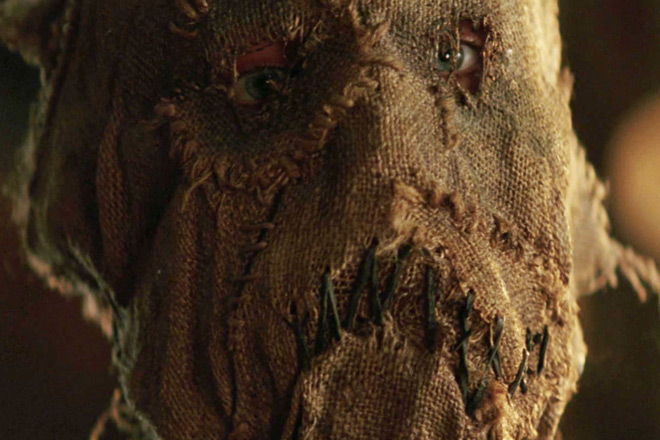
The movie also needed more colorful villains than a bunch of mafiosos. Nolan wanted to use Bat-villains that had not appeared in any film up to that point. Scarecrow only got as far as the Batman: Unchained project, so he was included as a secondary villain. At the same time, Ra’s Al-Ghul got the central villain role, as Goyer was intrigued by his motives (“He’s not bent on revenge: he’s actually trying to heal the world. He’s just doing it by very draconian means”).
This also influenced his casting. Al-Ghul is instrumental in teaching Wayne how to fight and, eventually, to become the Bat. Yet he is also behind its fiendish plot to use a stolen microwave emitter to turn Gotham’s fear toxin-contaminated water into vapor, which would gas its citizens into attacking each other. He is a mentor and a villain at the same time, and since Liam Neeson (Kinsey 2004, The Naked Gun 2025) was known at the time for playing mentor roles, the production felt he would fit the role perfectly, shocking viewers by revealing the villain is an evil Qui-Gon Jin.
Then there was Batman himself. Even if none of those other Bat-projects existed, there are multiple alternative timelines where Batman Begins was made with different actors who were considered for the role, including future Joker Heath Ledger (A Knight’s Tale 2001, Brokeback Mountain 2005), eventual Scarecrow Cillian Murphy (28 Days Later 2002, The Wind That Shakes the Barley 2006), and the later Man of Steel Henry Cavill (The Witcherseries, Mission: Impossible- Fallout 2018). Yet Bale got the part, as Nolan said, “he has exactly the balance of darkness and light that we’re looking for.”

This worked once the movie hit theaters in June 2005, as Bale’s Wayne comes off as a tormented figure. He wants to avenge his parents and make Gotham better, yet is unsure of how to do it until he cottons onto his Batman idea. Even then, it takes the guidance of his butler and foster father Alfred (Michael Caine: Get Carter 1971, The Prestige 2006) to help him out when all seems lost (“Why do we fall, sir? So we can learn to pick ourselves up”). It makes him a more central, sympathetic figure than prior Batmen, whose plights often felt secondary to their villains’ whims.
Bale also had to put in a lot of work to get the part, too. On top of training in different forms of combat and reading up on the character to help him stand out, he had to bulk up. He has previously dropped weight to 120lbs for the 2004 movie The Machinist. Now he had to regain 100lbs of that in muscle in just a few months. If that sounds crazy, then what is crazier is that Bale ended up overachieving by 30 pounds. Luckily, he had slimmed down by the time filming began.
Yet as impressive as his physical transformation was, and as believable as his performance as Wayne is, it was his Batman that got people talking, and not necessarily for the right reasons. He is an imposing presence, yet Batman Begins’ trailer suggested he would be a more soft-spoken, shadowy figure akin to Robert Pattinson (Twilight 2008, Mickey 17 2025) in 2022’s The Batman 17 years later. Instead, he was growly and gravelly in a way that often bordered on parody (“DO I LOOK LIKE A COP?!”).
Even so, it is an on-point performance compared to Holmes as Dawes. Playing the love interest to a superhero is a rather thankless task, as they rarely have much to do, and Holmes’ performance reflects that, as it is not very inspired. She holds up better when she plays Dawes in District Attorney mode, trying to crack down on Scarecrow and Falcone, or when she is reprimanding Wayne for his initial revenge plot. But she has little chemistry with Bale, and her wooden line reads stick out more than Batman’s gargling-tar voice.
Then, while it is more down-to-earth than prior Bat-flicks, people have found issues with the plot and the theming. If Al-Ghul’s microwave emitter could evaporate all fluids within a city-wide radius, it would surely murder everyone in Gotham by drying them out instead? Or how blasé Alfred and Lucius Fox (Morgan Freeman: Se7en 1995, Coming 2 America 2021) are about his plans to dress up as a bat for the former and ask for his own personal Tumbler (“Does it come in black?”). For a realistic take, it still sounds rather comic-book-like.
Even then, others felt it was too serious and po-faced for its material. David Denby of the New York Times did not care for “the dull earnestness of the screenplay,” preferring Burton’s more artistic take. While Salon.com’s Stephanie Zacharek did not think it did justice to Batman’s emotions. Though they tended to be outliers, most critics, like Kyle Smith of the Wall Street Journal, felt it succeeded in combining Serpico-style cop drama with superheroics.
The most surprising plaudits the movie got likely came from Roger Ebert and Tim Burton (Edward Scissorhands 1990, Corpse Bride 2005) himself. The late film critic did not care for prior Bat-flicks and felt ‘film noir’ and ‘superheroes’ did not go together. Yet he gave Batman Begins a full 4/4 stars, calling it “the Batman movie I’ve been waiting for,” and even loving the divisive, tank-like look of the Tumbler alongside other interpretations of Batman’s equipment, including the Bat-signal. While Burton felt it succeeded at going into darker territory than his Bat-flicks could not dive into, saying it “captured the real spirit that these kinds of movies are supposed to have nowadays…Nolan certainly got more to the root of what the Batman comics are about.”
Today, Batman Begins is overshadowed by its sequel, The Dark Knight, which got grittier, grimmer, offered more food for thought in its plot, and had better action scenes, as Begins’ sequences are notoriously scrappy. Yet thanks to its more realistic focus, it has aged well over 20 years, compared to the very 1990s-looking Burton and Schumacher films. The cast’s age aside, the movie still looks like it could have been made in 2015 or 2025 rather than 2005.
Then, alongside what 2006’s Casino Royale did for James Bond, it showed rebooting a series with a starker take on its formula could be a recipe for success. Even its tie-in PS2 video game, with its mix of stealth gameplay, action sequences, and interrogations, would provide Rocksteady Studios with the framework for its Batman: Arkham video games, which would also reference the movie here and there (“I did ask if it came in black, but then I thought, nah, you’d just get jealous”).
So, while the Batman franchise is in new cinematic hands, if Batman Begins had not hit the screens, 2022’s The Batman and its upcoming sequel would have looked very different, if they even would have happened at all. Batman might have ended up trapped in cinematic limbo for longer. Yet thanks to Batman Begins, the gritty mood from the comics managed to hit the screen, inspiring nearly all subsequent Bat-flicks since.


No comment