
While you can look back to the 1930s as the originator of the Horror film franchise with the likes of Universal’s Frankenstein and Dracula films, the 1980s took it to an entirely new level. In the decade following the 1970s brand of Horror, which was full of raw, realistic themes and disturbing films like 1973’s The Exorcist, 1974’s The Texas Chainsaw Massacre, and 1978’s Dawn of the Dead, a new era emerged where Horror was becoming more mainstream. Getting a boost from the introduction of home video rentals and piggybacking on the late ’70s success of Slasher-style films like 1978’s Halloween, 1980 saw the release of Friday the 13th. A new era, this laid the foundation for one of Horror’s most notorious characters, Jason Voorhees. However, proficient Horror Director Wes Craven was ready to change the entire playing field in 1984 with his original film A Nightmare on Elm Street.
Over a decade removed from his gritty, shocking debut Horror film, 1972’s The Last House on the Left (which was produced by original Friday the 13th Director Sean S. Cunningham), and seven years after the equally intense 1977 film The Hills Have Eyes, Craven was ready to unleash an entirely new form of terror with Freddy Krueger. A nightmarish figure with a knife-finger glove, Freddy was not initially planned to be the focal point of the original A Nightmare on Elm Street. In fact, Craven’s true objective was to drive home the terror of potentially dying in your sleep during a nightmare. Something everyone fears, since we all wake up before something truly terrible happens, the standard theory is that if you die in your sleep, you die in real life. Nonetheless, Craven’s dream stalking Freddy Krueger grew into more than just a vehicle of fear; he became the fear itself.
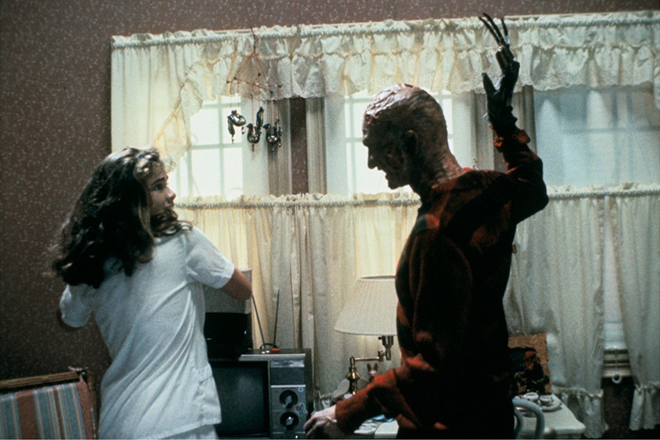
When an idea hits public eyes, this is just the way it goes, and because of the interest in Freddy, the then-fresh New Line Cinema (which grew into a mega production company) took the idea and ran with it for not one or two sequels, but five more films over the next seven years into 1991. Becoming one of the most successful Horror franchises of the ’80s, alongside Halloween and Friday the 13th, Freddy Krueger became the face of ’80s Horror. Crowned the center of A Nightmare on Elm Street, each sequel featured a different cast that faced new challenges in stopping his killing rampage. A concept that drew in tons of viewers, the peculiar aspect is that, in some strange way, people started to cheer for Freddy.
Yes, despite Freddy being a horribly burnt child killer who has come to life in dreams only to kill more, people began to like him. An evolution that transpired with each passing sequel in the series, Freddy swiftly developed a charismatic personality with witty one-liners and animated moves that made many laugh. Similar to what happened with both Michael Myers of the Halloween films and Jason Voorhees of the Friday the 13th series, chances are, if you lived in the ’80s and ’90s, you saw tons of Halloween costumes for all age groups portraying these characters. However, the big difference is that Freddy Krueger was an emotive villain on screen who spoke with inflection and had a personality, unlike the mute masked types of Jason and Michael Myers.
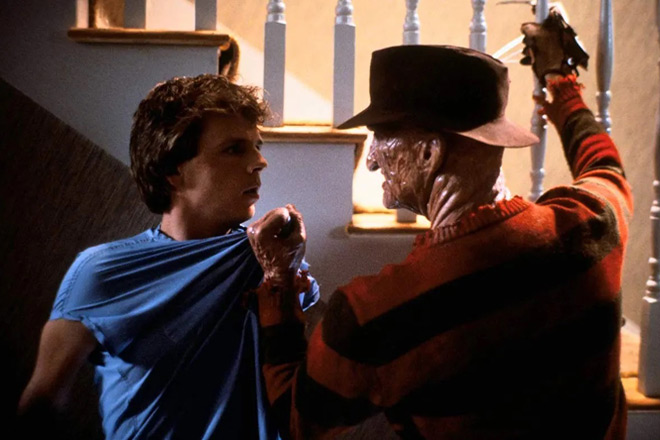
Interestingly enough, one attribute that makes Freddy Krueger and the A Nightmare on Elm Street films some of the most beloved of the big three Horror franchises of the ’80s is that everyone has their favorite from the initial selection of movies. Of course, no one can go wrong with Craven’s original, which was actually the most legitimately scary in the series and the least humor-riddled. Then some see the overlooked brilliance of 1985’s A Nightmare on Elm Street 2: Freddy’s Revenge (directed by Jack Sholder and featuring a solid performance from Mark Patton).
Beyond this, many would turn to 1987’s A Nightmare on Elm Street 3: Dream Warriors (directed by Chuck Russell) as their definitive favorite in the series, thanks to a unique style and killer music led by Dokken’s title track. However, you will even find those who love the direction Renny Harlin took A Nightmare on Elm Street 4: The Dream Master in 1988, which became the most successful of the entire franchise at the box office at that time. This led to 1989’s A Nightmare on Elm Street 5: The Dream Child (this time directed by Stephen Hopkins), followed by 1991’s Freddy’s Dead: The Final Nightmare (directed by Rachel Talalay), before Wes Craven himself returned for the surprise return film, 1994’s Wes Craven’s New Nightmare.
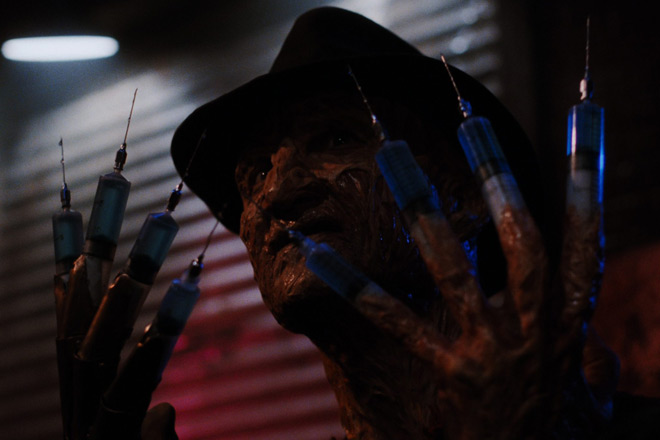
In truth, franchise fans consider these seven films to be A Nightmare on Elm Street. To many, this excludes 2003’s highly anticipated Freddy vs. Jason, followed by the arguably unwanted 2010 remake, A Nightmare on Elm Street. That is why most fans will always be pleased to see a franchise box set arrive with the original seven flicks, no matter the time or place. Looking back, the collector’s sets began arriving in 1999, featuring both a VHS and DVD box set, which were spectacular in terms of presentation and included everything anyone could ask for. Then, in 2013, a scaled-back (in terms of size) Blu-ray set came out that had many fans excited. From here, 1984’s A Nightmare on Elm Street had a respectable 4K Ultra HD release in 2024, but now in 2025 comes the ultimate A Nightmare On Elm Street 7-Film Collection in 4K Ultra HD.
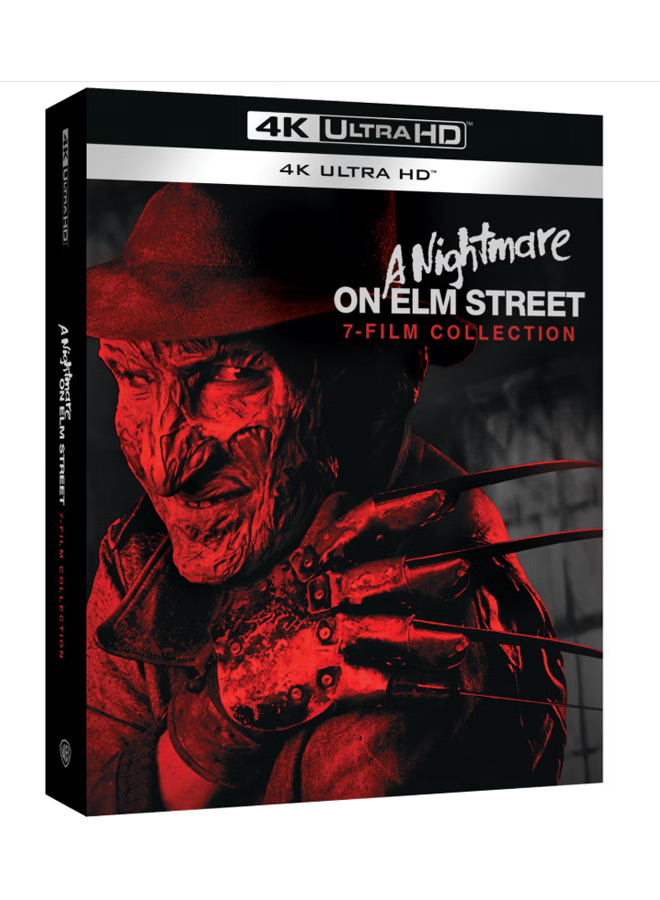
Released on September 30, 2025, through Warner Bros. Discovery Home Entertainment, the set features all seven original films in high-quality 4K Ultra HD, plus some cool extras. Available as a standard 4K Ultra set, each film is on its own respective disc in a multi-disc plastic box that includes a nice cardboard slipcase. Featuring a relatively standard photo of Freddy Krueger as the art, it is not awful, but some might wish perhaps a different art had been selected. Nonetheless, you also get a cool set of 3D glasses to wear during the 3D portion of Freddy’s Dead: The Final Nightmare. Another great bonus is the inclusion of the theatrical and uncut edition of A Nightmare on Elm Street (available in the standalone 4K release from 2024), along with the theatrical and uncut version of A Nightmare on Elm Street 5: The Dream Child. Great to see everything together, the transfer to 4K Ultra HD is quite noticeable compared to the former Blu-ray edition, and the upgrade is welcome.
Added to everything, you also have special features such as commentary from Wes Craven, Robert Englund, Heather Langenkamp, Ronee Blakley, Robert Shaye, and Sara Risher, alternate endings, and cool featurettes like The House that Freddy Built: The Legacy of New Line Horror, Night Terrors: The Origins of Wes Craven’s Nightmares, and Never Sleep Again: The Making of A Nightmare on Elm Street, plus much more.
Altogether, this new set is a fantastic addition to any fan’s collection and is perfectly timed for Halloween and the holiday season to follow. Furthermore, if you are a fan who likes much more, there is also the pricey but very cool limited edition A Nightmare on Elm Street 7-Film Collection 4K Limited Steelbook Edition to look into. Anyway you go is a good choice, and that is why Cryptic Rock gives A Nightmare On Elm Street 7-Film Collection in 4K Ultra HD 4.5 out of 5 stars.


)
No comment